- Chemistry
- Ready-made model
- Printed report included
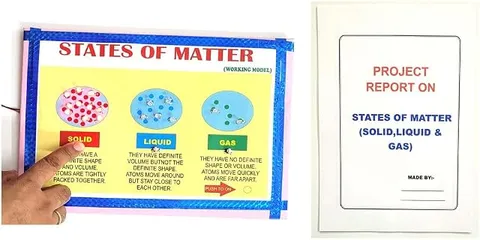
States of Matter Chemistry Educational Science Working Model with Report for School and Colleges
Code B0DK229SN8
- Paid for and delivered by Amazon. The current price and the delivery date for your PIN code are shown there.
- Sold by Gurukul Technicals Institute, Delhi.
- Need a different topic, a custom version or a school order? Ask on WhatsApp.
In this project guide
Ready-made model
About this model
This chemistry working model explains the three common states of matter, solid, liquid and gas, and how matter changes from one state to another. The listing says a report is included, which can help with the written work for the project.
How it works
The science behind it
The idea the model demonstrates, in words you can use in your report and when you explain it.
All matter is made of tiny particles that are always moving, have spaces between them and attract one another. In a solid, particles are packed closely and only vibrate about fixed positions, so a solid has a fixed shape and volume. In a liquid, particles are a little farther apart and can slide past each other, so a liquid has a fixed volume but takes the shape of its container. In a gas, particles are far apart and move freely, so a gas has no fixed shape or volume and is easily compressed. At normal atmospheric pressure, ice melts at 0 °C (273 K) and water boils at 100 °C (373 K). During melting and boiling the temperature stays constant, because the heat, called latent heat, is used to overcome the forces between particles. Camphor changes straight from solid to gas, which is called sublimation. Water in an earthen matka stays cool because evaporation from its surface takes heat away.
Make it yourself
Make a states of matter particle model yourself
Build your own version from scratch, or use the steps to understand how the ready-made model is put together before you present it.
What you need 8
Step by step 7 steps
Glue beads in tight rows across the bottom of the first box to show a solid, whose particles only vibrate in place.
Fill the second box about three-quarters full with loose beads to show a liquid, whose particles are close but can slide past one another.
Put only a few beads in the third box to show a gas, whose particles are far apart.
Fix a motor with an off-centre weight under the liquid and gas boxes, which stand on sponge pads, and wire each to its own cells and switch; when they run, the beads jiggle like particles gaining energy when heated.
Fill one syringe with air and one with water, seal each nozzle with clay, and let visitors push the plungers to feel which one can be compressed.
Arrange arrows between the boxes for melting, freezing, evaporation, condensation, sublimation and deposition.
Label each box with the properties of that state: its shape, its volume and how easily it is compressed.
Read this first
Safety first
Go through these points before you build or switch anything on. Younger students should do this with an adult.
- Use needle-free syringes only.
- If you show melting or boiling, an adult must handle the heat source and any hot water.
- Do not use naphthalene balls to show sublimation, as their vapour is harmful; leave that demonstration to your teacher.
- Ask an adult to use the glue gun.
Troubleshooting
If something does not work
The usual problems with this model and how to fix them. Open a problem to see the fix.
The beads barely move when the motor runs
Use a heavier off-centre weight or fix the motor directly against the bottom of the box.
The whole box walks across the table
Stand it on sponge pads and fix the base board down.
The water syringe moves a little when pressed
A small air bubble is trapped. Refill it under water so it is completely full.
Beads stick to the walls of the gas box
Static is holding them. Wipe the inside with a slightly damp cloth and let it dry.
Exhibition day
How to present it
A running order for the exhibition table or the practical, step by step.
Compare the three states in a simple table: arrangement of particles, shape, volume and compressibility.
Show the changes of state as a cycle of melting, boiling, condensation and freezing, with sublimation as a shortcut from solid to gas.
Keep a small piece of camphor in a closed box and open it to show that it slowly turns into vapour without melting.
Use the matka example to explain cooling by evaporation in a way every visitor understands.
Practice
Viva questions
Practice questions on this model, with short answers. Try each one aloud before you open the answer.
Why are gases easily compressed?
Gas particles have large spaces between them, so they can be pushed closer together.
What is sublimation? Give an example.
Sublimation is the change of a solid directly into a gas without becoming a liquid, as seen with camphor or dry ice.
Why does the temperature stay constant while ice is melting?
The heat supplied is used as latent heat to overcome the forces of attraction between particles, not to raise the temperature.
Why does water in an earthen pot stay cool in summer?
Water seeps through the pores and evaporates from the outer surface, and evaporation takes heat from the pot and the water inside.
Project file
Project file outline
The headings of the project file, in order. Give each heading its own section and write it in your own words.
The listing includes a printed project report: use this outline to check that your own file covers every part.
Free ebook: Writing a Science Project FileContents
- Aim: to show the arrangement and movement of particles in solids, liquids and gases, and how matter changes state
- Materials
- Characteristics of the three states of matter
- Particle arrangement shown in the three boxes
- Changes of state and their names
- Activity: compressing air and water in syringes, with observations
- Effect of temperature and pressure on the state of matter
- Conclusion
Buying checklist
Before you buy
What to check before you order the model.
1Check these first
- States of matter are taught in middle school and in Class 9 science; check whether your teacher also wants sublimation and the effect of pressure.
- Check in the listing whether any part moves or lights up, and what batteries it needs.
- If a report is included, add your own observations from the syringe activity.
- Try the model a few days before the exhibition and reglue any loose beads.
- Keep the box so the clear boxes do not crack.
- Check the delivery date for your PIN code on the marketplace, and order well before the exhibition or practical.
- Practise explaining it. Judges ask what the model shows and why; knowing the science matters as much as the model. The viva questions above are a good place to start.
Next steps
Take it further
Ways to turn this model into a bigger investigation or a stronger exhibition entry.
With an adult, heat crushed ice and record its temperature every minute to plot a heating curve with flat parts where the state changes.
Compare how fast a drop of food colour spreads in hot and in cold water, linking particle motion to temperature.
Add a fourth box for plasma, with a note on where it occurs, such as lightning and the Sun.
Audience
Who it suits
Suits Class 6 to 9 science exhibitions and lessons on matter and its states.
- SubjectChemistry
- TypeReady-made model
- Project reportPrinted report included
Free to read
Free ebooks for this topic
Free PDF ebooks from Gurukul Technicals Institute on the science, the making and the presenting of projects like this one.
- Free PDF ebook
Safe Chemistry Projects for School
Experiments and models with kitchen materials and proper safety
- Free PDF ebook
Your Science Exhibition Guide
Choose a project, build it, present it and answer the judges with confidence
- Free PDF ebook
Writing a Science Project File
How to write the report, from the cover page to the bibliography
- Free PDF ebook
Viva Questions for Science Projects
How to answer examiner questions, with sample questions for popular projects