- Chemistry
- Ready-made model
- Class 10 to 12
Fractional Distillation Working Model
Code B0G2T5MYLC
- Paid for and delivered by Amazon. The current price and the delivery date for your PIN code are shown there.
- Sold by Gurukul Technicals Institute, Delhi.
- Need a different topic, a custom version or a school order? Ask on WhatsApp.
In this project guide
Ready-made model
About this model
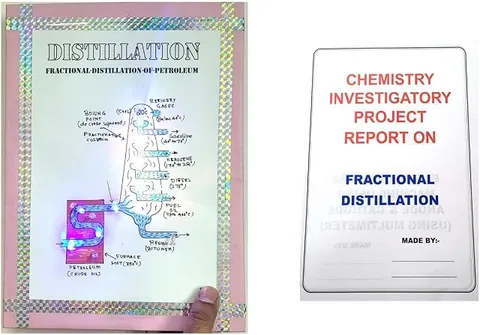
This model shows fractional distillation, the method used to separate a mixture of liquids that boil at different temperatures. It is a clear way to explain how crude oil is split into petrol, diesel, kerosene and other products, and how pure substances are obtained from mixtures.
What the listing says
- Chemistry Investigatory Project Educational Electronic Hobby Kit
How it works
The science behind it
The idea the model demonstrates, in words you can use in your report and when you explain it.
When a mixture of miscible liquids is heated, the liquid with the lower boiling point turns into vapour first. In fractional distillation the vapour rises through a fractionating column packed with glass beads or fitted with plates. The column is hotter at the bottom and cooler at the top, so vapours keep condensing and boiling again as they climb. The component with the lower boiling point reaches the top and passes into the condenser, while the higher-boiling one falls back. This method is used when boiling points differ by less than about 25 K; for larger differences simple distillation is enough. Ethanol (about 78 °C) and water (100 °C), which differ by only 22 degrees, are a classic example. In oil refineries such as those at Mathura, Panipat and Jamnagar, crude oil is separated this way into LPG, petrol, kerosene, diesel, lubricating oil and bitumen, with the lightest fractions collected highest.
Make it yourself
Make a fractional distillation model yourself
Build your own version from scratch, or use the steps to understand how the ready-made model is put together before you present it.
What you need 8
Step by step 8 steps
Cut slots at equal heights in the column and fit the trays inside, so it looks like the tray tower of a refinery.
Fix a straw outlet at each tray and lead it to a small bottle of coloured water beside the tower.
Stand the column on the furnace box and place the red LED inside the box to show where the crude oil is heated.
Fix an LED at each outlet, with deeper colours at the bottom for the heavy, high-boiling fractions and lighter colours at the top for the light, low-boiling ones.
Wire all the LEDs in parallel, each with its resistor, to the battery through one switch hidden in the base.
Label each outlet with its fraction and one use, from the top: gases, petrol, kerosene, diesel, lubricating oil, and bitumen at the bottom. Check the names against your textbook.
Draw arrows for vapour rising and liquid falling back inside the column, and a scale showing hot at the bottom and cool at the top.
Place the laboratory set-up chart beside the tower so you can explain both the classroom and the refinery versions.
Read this first
Safety first
Go through these points before you build or switch anything on. Younger students should do this with an adult.
- This model shows the process without heating anything; never heat petrol, kerosene, alcohol or any flammable liquid at home.
- Real distillation is done only in a school lab by a teacher, with proper glassware and ventilation.
- Cutting the bottle or pipe and using hot glue need an adult.
- Use coloured water, never real fuels, in the display bottles.
Troubleshooting
If something does not work
The usual problems with this model and how to fix them. Open a problem to see the fix.
The trays will not stay level inside the column
Cut the slots at exactly the same height all round, or rest each tray on a ring of tape stuck inside the column.
Some LEDs do not light
Check each LED's polarity and resistor, and make sure they are wired in parallel, not in a chain, so each gets enough voltage.
Visitors cannot tell the fractions apart
Use clearly different colours, large labels and arrows, and line up the bottles in order beside their outlets.
The coloured water leaks from the bottles
Seal the caps with tape or a little glue, and carry the bottles to school separately.
Exhibition day
How to present it
A running order for the exhibition table or the practical, step by step.
Label the column from bottom to top with the fractions that would collect at each level.
Explain the 25 K rule and give one example each of simple and fractional distillation.
Never heat flammable liquids at the stall; explain the process with the model and a flow chart instead.
Link the model to the petrol and LPG used at home, so judges see why it matters.
Practice
Viva questions
Practice questions on this model, with short answers. Try each one aloud before you open the answer.
When is fractional distillation used instead of simple distillation?
When the liquids in the mixture are miscible and their boiling points differ by less than about 25 K.
What is the purpose of the fractionating column?
It gives surfaces on which vapours repeatedly condense and evaporate, so the lower-boiling liquid is separated more completely before it reaches the condenser.
Name the gases of air separated by fractional distillation.
Nitrogen, oxygen and argon are separated by the fractional distillation of liquefied air.
Which fraction of petroleum collects at the top of the column?
The lightest fraction with the lowest boiling point, petroleum gas (LPG), collects at the top.
Project file
Project file outline
The headings of the project file, in order. Give each heading its own section and write it in your own words.
Free ebook: Writing a Science Project FileContents
- Aim: to show how fractional distillation separates a mixture of liquids with different boiling points
- Introduction: mixtures, pure substances and why we separate them
- Simple distillation and fractional distillation compared
- Laboratory set-up: flask, fractionating column, thermometer, condenser and receiver
- Principle: vapours condense and boil again as they rise through the column
- Fractional distillation of crude oil, its main fractions and their uses
- Description of the model and how it was made
- Other uses: separating the gases of liquid air and alcohol from water
- Conclusion: why separating by boiling point is useful, and bibliography
Buying checklist
Before you buy
What to check before you order the model, and what to do when it arrives.
1Before you order
- Read the listing to see how the model shows the process (lights, labels or moving parts) and whether a report is included.
- Match it to your class Separation of mixtures in the lower classes, petroleum and fuels in the higher ones.
- Practise explaining why the column is hot at the bottom and cool at the top.
- Keep the box, because a tall column breaks easily in a school bag.
- Check the delivery date for your PIN code on the marketplace, and order well before the exhibition or practical.
2When it arrives
- On arrival, test any lights and check that the labels match your textbook's names for the fractions.
Next steps
Take it further
Ways to turn this model into a bigger investigation or a stronger exhibition entry.
Ask your teacher to demonstrate the separation of an alcohol and water mixture in the lab, and record the thermometer readings in your report.
Add a chart of the boiling ranges and carbon-atom counts of the crude oil fractions, taken from your textbook.
Explain how nitrogen, oxygen and argon are separated by the fractional distillation of liquid air.
Audience
Who it suits
Suits Class 8 to 11 chemistry projects on separation of mixtures and petroleum, and science exhibitions on refining.
- ClassClass 10 to 12
- SubjectChemistry
- TypeReady-made model
Free to read
Free ebooks for this topic
Free PDF ebooks from Gurukul Technicals Institute on the science, the making and the presenting of projects like this one.
- Free PDF ebook
Safe Chemistry Projects for School
Experiments and models with kitchen materials and proper safety
- Free PDF ebook
Maths Working Models and Activities
Make maths visible: models for number, geometry, algebra and data
- Free PDF ebook
Investigatory Projects for Class 11 and 12
Topics, method and report structure for physics, chemistry and biology
- Free PDF ebook
Your Science Exhibition Guide
Choose a project, build it, present it and answer the judges with confidence