- Physics
- Ready-made model
- Class 10 to 12
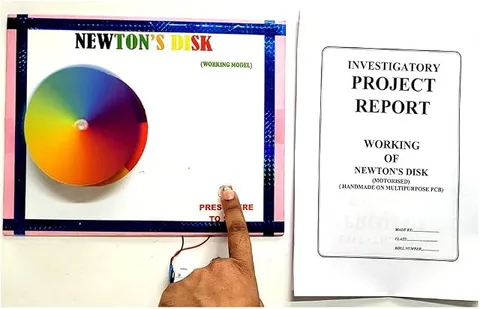
Newtons Disk Motorised Physics Investigatory Minor Project and Model
Code B0C3H5KVC9
- Paid for and delivered by Amazon. The current price and the delivery date for your PIN code are shown there.
- Sold by Gurukul Technicals Institute, Delhi.
- Need a different topic, a custom version or a school order? Ask on WhatsApp.
In this project guide
Ready-made model
About this model
A Newton's disc carries the seven colours of the rainbow in sectors, and in this motorised model a motor spins it fast. As it spins, the separate colours blend and the disc looks almost white, showing that white light is a mixture of seven colours.
How it works
The science behind it
The idea the model demonstrates, in words you can use in your report and when you explain it.
White light from the Sun is made of seven colours, remembered as VIBGYOR: violet, indigo, blue, green, yellow, orange and red. Isaac Newton showed this by splitting sunlight with a glass prism, and the disc demonstrates the reverse, putting the colours back together. When the disc spins fast, each colour passes the same spot in front of our eye many times a second. The eye keeps an image for about 1/16 of a second after it disappears, an effect called persistence of vision, so the colours overlap and the brain sees them as one mixed colour close to white. In practice the disc looks off-white or light grey, because paints are not pure spectral colours. The same persistence of vision makes the blades of a running ceiling fan look like a blurred disc, while a rainbow after monsoon rain shows the colours separated again.
Make it yourself
Make a motorised Newton's disc yourself
Build your own version from scratch, or use the steps to understand how the ready-made model is put together before you present it.
What you need 8
Step by step 8 steps
Draw a circle about 12 cm across on the card, mark its centre, and divide it into seven equal sectors of about 51° each; for better mixing, make fourteen sectors and repeat the colours twice.
Colour the sectors in rainbow order, keeping each colour bright and even, and let them dry.
Cut out the disc carefully and make a tiny hole exactly at the centre.
Glue the hub to the centre of the disc and push it onto the motor shaft so the disc sits square and does not wobble.
Fix the motor upright on the stand and wire it through the switch to the cell holder.
- Switch on and watch
As the disc speeds up, the colours blend and it looks nearly white or light grey.
Try two cells and then three, and note how the appearance changes with speed.
Make two-colour discs, such as red with green or blue with yellow, and record the blended colour you see for each.
Read this first
Safety first
Go through these points before you build or switch anything on. Younger students should do this with an adult.
- Keep fingers, hair and loose sleeves away from the spinning disc, and switch off before touching it.
- Fix the disc firmly to the hub so it cannot fly off the shaft.
- Use scissors carefully, and the glue gun only with an adult.
- Do not run the motor on more cells than it is rated for, as it can overheat.
Troubleshooting
If something does not work
The usual problems with this model and how to fix them. Open a problem to see the fix.
The colours do not blend
The disc is spinning too slowly or the sectors are too big. Use fresh cells, and try a disc with the colours repeated two or three times.
The disc wobbles or shakes
The hole is not at the exact centre. Find the centre again with a compass, make a new disc and fix it square on the hub.
The disc looks greyish or brownish, not white
Paints and inks reflect impure colours and absorb some light, so the blend is never pure white. Use lighter, brighter shades and show it in good daylight.
The disc slips on the shaft
The hub is loose. Use a tighter-fitting cap or add a drop of glue, and let it set fully before switching on.
Exhibition day
How to present it
A running order for the exhibition table or the practical, step by step.
Show the disc at rest first and name the seven colours in order.
Switch on the motor and ask the audience what colour they now see.
Explain honestly why the disc looks off-white rather than pure white.
Link it to a prism or a rainbow to show splitting and recombining of light.
Practice
Viva questions
Practice questions on this model, with short answers. Try each one aloud before you open the answer.
What does Newton's disc prove?
It proves that white light is a mixture of seven colours.
Why does the disc appear white when it rotates fast?
Because of persistence of vision: the eye retains each colour for about 1/16 of a second, so all the colours overlap and mix.
What is dispersion of light?
The splitting of white light into its component colours, for example by a glass prism.
Why does the spinning disc look slightly grey instead of pure white?
The paints are not pure spectral colours and each reflects only part of the light, so the mixture looks dull white or grey.
Project file
Project file outline
The headings of the project file, in order. Give each heading its own section and write it in your own words.
Free ebook: Writing a Science Project FileContents
- Aim: to show with a motorised Newton's disc that white light is made of seven colours
- Dispersion of white light by a prism and the spectrum VIBGYOR
- Persistence of vision and how it blends the colours
- Making the disc: sector angles and colours
- The motor circuit and how its speed was changed
- Observations at different speeds and with two-colour discs
- Why the disc looks off-white rather than pure white
- Conclusion and precautions
Buying checklist
Before you buy
What to check before you order the model, and what to do when it arrives.
1Before you order
- Check that the project suits your class and the chapter on light or the human eye.
- Read the listing for the batteries the motor needs; do not assume they are in the box.
- Demonstrate it in good light, as dim light makes the blended colour look grey.
- Keep the box so the disc is not bent or creased in transport.
- Check the delivery date for your PIN code on the marketplace, and order well before the exhibition or practical.
- Practise explaining it. Judges ask what the model shows and why; knowing the science matters as much as the model. The viva questions above are a good place to start.
2When it arrives
- When it arrives, run the motor and check that the disc spins straight without wobbling.
Next steps
Take it further
Ways to turn this model into a bigger investigation or a stronger exhibition entry.
Record the spinning disc in slow motion on a phone and show how the separate colours reappear when it is slowed down.
Make a Benham's disc with only black and white patterns, spin it, and describe the faint colours people report seeing.
Split white light with a glass prism onto a screen and set it beside the disc to show splitting and recombining side by side.
Audience
Who it suits
Class 6 to 10 students making an exhibition model on light, colour and the human eye.
- ClassClass 10 to 12
- SubjectPhysics
- TypeReady-made model
Free to read
Free ebooks for this topic
Free PDF ebooks from Gurukul Technicals Institute on the science, the making and the presenting of projects like this one.
- Free PDF ebook
Electricity and Magnetism Experiments
Hands-on experiments with cells, wires, bulbs and magnets
- Free PDF ebook
Physics Working Models Explained
Twenty classic models, how each works and how to make it
- Free PDF ebook
Investigatory Projects for Class 11 and 12
Topics, method and report structure for physics, chemistry and biology
- Free PDF ebook
Your Science Exhibition Guide
Choose a project, build it, present it and answer the judges with confidence