- Physics
- Ready-made model
- Class 10 to 12
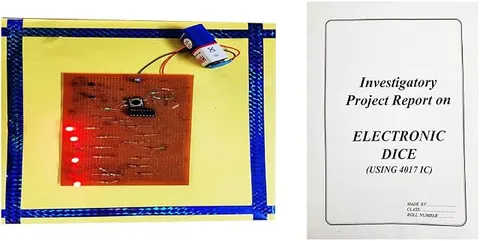
Electronic Dice Physics Working Model Educational Investigatory Project
Code B0BN2G3YG7
- Paid for and delivered by Amazon. The current price and the delivery date for your PIN code are shown there.
- Sold by Gurukul Technicals Institute, Delhi.
- Need a different topic, a custom version or a school order? Ask on WhatsApp.
In this project guide
Ready-made model
About this model
This electronic dice is a working model that gives a number from 1 to 6 electronically instead of rolling a real die. It combines electronics with probability, which makes it a good investigatory project for both science and maths.
How it works
The science behind it
The idea the model demonstrates, in words you can use in your report and when you explain it.
An electronic dice usually has two parts. An oscillator, often a 555 timer in astable mode, produces clock pulses thousands of times a second. A counter IC counts these pulses and repeats a cycle of six states, each state shown as one face of the dice. While the circuit is running, the counter races through 1 to 6 far too fast for the eye to follow; when it stops, it stops wherever the count happens to be. Since nobody can time that moment to a fraction of a millisecond, every number is equally likely, and the probability of each is 1/6. This is theoretical probability: P(E) = number of favourable outcomes / total number of outcomes. If you record 120 throws, each number should appear roughly 20 times, and the experimental results get closer to 1/6 as the number of throws grows. On a real die, the numbers on opposite faces always add up to 7.
Make it yourself
Make an electronic dice with seven LEDs yourself
Build your own version from scratch, or use the steps to understand how the ready-made model is put together before you present it.
What you need 10
Step by step 8 steps
Build the 555 as a fast clock: 1 kΩ from pin 8 to pin 7, 10 kΩ from pin 7 to pins 2 and 6 (joined), 0.1 µF from pins 2 and 6 to negative, pins 4 and 8 to positive, pin 1 to negative, and 0.01 µF from pin 5 to negative. It runs at roughly 700 pulses a second.
- Wire the CD4017
Pin 16 to positive, pin 8 to negative, pin 14 to the 555's pin 3, and the reset, pin 15, to output Q6 (pin 5), so it counts only Q0 to Q5 and then starts again.
Connect pin 13 to positive through a 10 kΩ resistor, and the push button from pin 13 to negative. While pin 13 is high the count stops, so the dice rolls only while the button is pressed.
Arrange the seven LEDs as a die face and group them: the centre LED (C), the top-left and bottom-right pair (A), the top-right and bottom-left pair (B), and the middle-left and middle-right pair (D). The two LEDs in each pair go in series.
Drive each group with a BC547: the LEDs and their resistor (330 Ω for each pair, 470 Ω for the centre) from the positive line to the collector, the emitter to negative, and a 10 kΩ resistor into the base.
Feed each base resistor through diodes, band towards the resistor: C from Q0, Q2 and Q4; A from Q1, Q2, Q3, Q4 and Q5; B from Q3, Q4 and Q5; and D from Q5 only. This gives faces 1 to 6 in turn.
Press and release the button many times and check that every face from 1 to 6 appears correctly. Fix any wrong face by checking its diodes.
Roll the dice 120 times, tally the results, and compare each count with the expected 20.
Read this first
Safety first
Go through these points before you build or switch anything on. Younger students should do this with an adult.
- Use the soldering iron only with an adult, rest it in its stand, and let joints cool before handling the board.
- Fit the ICs, transistors and diodes the right way round, and check the wiring against your diagram before connecting the battery.
- Switch off before changing any part, and never let the battery leads touch each other.
- Trim LED and diode legs with the cutters pointing down, away from your eyes.
Troubleshooting
If something does not work
The usual problems with this model and how to fix them. Open a problem to see the fix.
One face shows the wrong dots
A diode for that output is in the wrong group or the wrong way round. Compare that face's output with the diode list and fix the diode.
Sometimes no LEDs light after a roll
The reset is not on Q6, so the counter runs on to Q9 and has four blank states. Connect pin 15 to pin 5.
The LEDs keep changing after the button is released
Pin 13 is not held high. Check the 10 kΩ resistor from pin 13 to positive, and that the button is the normally open type.
One pair of LEDs never lights
One LED in the series pair may be reversed or faulty, which breaks the pair, or its transistor may be wired wrongly. Test each LED and check the transistor legs.
Exhibition day
How to present it
A running order for the exhibition table or the practical, step by step.
Roll the dice 60 or 120 times with the audience and keep a tally of the results.
Compare your tally with the expected 1/6 for each number and discuss the difference.
Explain why the count runs too fast for anyone to choose a number.
Draw a block diagram showing the oscillator, the counter and the display.
Practice
Viva questions
Practice questions on this model, with short answers. Try each one aloud before you open the answer.
What is the probability of getting a 4 on a fair die?
1/6, because there is one favourable outcome out of six equally likely outcomes.
Why is the result of the electronic dice random?
The counter cycles through the six numbers thousands of times a second, so nobody can control where it stops.
What is the job of the oscillator in this circuit?
It produces the fast clock pulses that the counter counts.
What is the difference between experimental and theoretical probability?
Theoretical probability is worked out from equally likely outcomes, while experimental probability comes from actual trials and gets closer to it as the number of trials increases.
Project file
Project file outline
The headings of the project file, in order. Give each heading its own section and write it in your own words.
Free ebook: Writing a Science Project FileContents
- Aim: to make an electronic dice and test whether every number is equally likely
- Introduction: probability and random events
- Theory: P(E) = favourable outcomes ÷ total outcomes, so each face has a probability of 1/6
- The 555 clock and the CD4017 counter reset at six
- How the diodes and transistors draw the dot patterns
- Circuit diagram and construction
- Observations: tally of 120 rolls and the relative frequency of each face
- Comparison of experimental and theoretical probability
- Conclusion and bibliography
Buying checklist
Before you buy
What to check before you order the model, and what to do when it arrives.
1Before you order
- Check that the project suits your class and whether your teacher wants it shown as a physics, electronics or maths project.
- Read the listing to see how the dice is rolled and what powers it, and keep a fresh battery ready.
- Prepare a tally of at least 100 rolls before the exhibition, as examiners like to see real data.
- Keep the box for transport.
- Check the delivery date for your PIN code on the marketplace, and order well before the exhibition or practical.
- Practise explaining it. Judges ask what the model shows and why; knowing the science matters as much as the model. The viva questions above are a good place to start.
2When it arrives
- Roll it many times as soon as it arrives to check every face lights correctly.
Next steps
Take it further
Ways to turn this model into a bigger investigation or a stronger exhibition entry.
Combine results from your classmates to reach 600 or more rolls, and show the relative frequencies getting closer to 1/6.
Add a capacitor so the dice slows down and stops by itself after the button is released, like a real die rolling to rest.
Build a second dice, record the totals of both, and compare them with the expected distribution that peaks at 7.
Audience
Who it suits
Class 9 to 12 students who want a project linking digital electronics with probability, and maths clubs looking for a hands-on demonstration.
- ClassClass 10 to 12
- SubjectPhysics
- TypeReady-made model
Free to read
Free ebooks for this topic
Free PDF ebooks from Gurukul Technicals Institute on the science, the making and the presenting of projects like this one.
- Free PDF ebook
Physics Working Models Explained
Twenty classic models, how each works and how to make it
- Free PDF ebook
Investigatory Projects for Class 11 and 12
Topics, method and report structure for physics, chemistry and biology
- Free PDF ebook
Your Science Exhibition Guide
Choose a project, build it, present it and answer the judges with confidence
- Free PDF ebook
Writing a Science Project File
How to write the report, from the cover page to the bibliography