- Biology
- Ready-made model
- Class 10 to 12
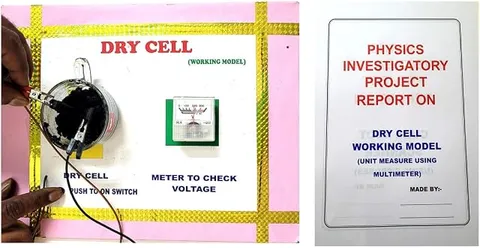
Dry Cell Chemistry Physics Investigatory Working Project & Model
Code B0G2TBYMCS
- Paid for and delivered by Amazon. The current price and the delivery date for your PIN code are shown there.
- Sold by Gurukul Technicals Institute, Delhi.
- Need a different topic, a custom version or a school order? Ask on WhatsApp.
In this project guide
Ready-made model
About this model
This investigatory model is about the dry cell, the familiar 1.5 V cell used in torches, remotes and clocks. It explains how a chemical reaction inside the cell produces electricity, linking chemistry and physics in one project.
How it works
The science behind it
The idea the model demonstrates, in words you can use in your report and when you explain it.
The common dry cell is the Leclanché type, also called a zinc-carbon cell. Its zinc container is the anode (negative terminal), and a carbon (graphite) rod in the centre is the cathode (positive terminal). The rod is surrounded by manganese dioxide and carbon powder, and the electrolyte is a moist paste of ammonium chloride and zinc chloride rather than a liquid, which is why it is called dry. At the anode, zinc is oxidised: Zn → Zn²⁺ + 2e⁻. The electrons flow through the outer circuit to the cathode, where manganese dioxide is reduced: MnO₂ + NH₄⁺ + e⁻ → MnO(OH) + NH₃. This redox reaction gives an emf of about 1.5 V. It is a primary cell, so it cannot be recharged once its chemicals are used up. The AA and AAA cells in a TV remote or a wall clock are everyday examples of dry cells.
Make it yourself
Make a dry cell cut-away model and lemon cell yourself
Build your own version from scratch, or use the steps to understand how the ready-made model is put together before you present it.
What you need 9
Step by step 8 steps
Ask an adult to cut a window down one side of the tube, so the model looks like a cell sliced open.
Stand the black rod in the centre of the tube and pack black clay around it to show the manganese dioxide and carbon mixture.
Press a thin layer of white clay between the black mixture and the tube wall to show the paste electrolyte and separator.
Add a sealing layer at the top, fix the cap on the rod as the positive terminal, label the case as the negative terminal, and label every layer.
For the working cell, push one zinc nail and one copper strip into each lemon, a few centimetres apart and not touching.
Measure one lemon with the multimeter on DC volts; it usually gives a little under 1 V.
Join the four lemons in series, copper of one to zinc of the next, and measure the total voltage.
Connect the red LED across the chain, long leg to the free copper end, and view it in a dim corner; it may glow only faintly because the current is tiny.
Read this first
Safety first
Go through these points before you build or switch anything on. Younger students should do this with an adult.
- Never cut open, crush or heat a real dry cell; the paste inside can irritate skin and eyes.
- Do not eat the lemons after the activity; throw them away.
- Nails and copper strips have sharp ends, so handle them carefully and let an adult use the cutter.
- Wash your hands after handling the lemons and metal pieces.
Troubleshooting
If something does not work
The usual problems with this model and how to fix them. Open a problem to see the fix.
The LED does not glow
The lemon cells give very little current. Add more lemons in series, use a red LED (it needs the least voltage), check its long leg is at the copper end, and look in a dark place.
One lemon reads almost zero
The nail and copper may be touching inside the lemon, or the nail may be plain iron rather than zinc-coated. Separate them, or use a proper galvanised nail.
The voltage falls after some time
Gas bubbles and used-up juice around the metals slow the reaction. Roll the lemon to release fresh juice and clean the metal pieces; in a real dry cell, manganese dioxide is there to stop this happening.
The total voltage is less than the lemons added together
One connection is reversed, joining copper to copper or zinc to zinc. Check that each link goes from copper to the next lemon's zinc.
Exhibition day
How to present it
A running order for the exhibition table or the practical, step by step.
Show a labelled cross-section of a dry cell and name each part along with its job.
Write the anode and cathode reactions on a chart and point out which is oxidation and which is reduction.
Measure a fresh cell and a used cell with a multimeter and compare their voltages.
Remind visitors never to open or burn old cells and to dispose of them as hazardous waste.
Practice
Viva questions
Practice questions on this model, with short answers. Try each one aloud before you open the answer.
Why is it called a dry cell?
Because its electrolyte is a moist paste instead of a free-flowing liquid, so it does not spill.
Which is the anode and which is the cathode in a dry cell?
The zinc container is the anode and the carbon rod is the cathode.
What is the voltage of a dry cell?
About 1.5 volts.
Can a dry cell be recharged?
No. It is a primary cell, so its chemical reaction cannot easily be reversed.
Project file
Project file outline
The headings of the project file, in order. Give each heading its own section and write it in your own words.
Free ebook: Writing a Science Project FileContents
- Aim: to explain how a dry cell turns chemical energy into electrical energy
- Introduction: electrochemical cells
- Structure of the Leclanché dry cell
- Reactions at the anode and the cathode
- Construction of the cut-away model
- Activity: making a lemon battery and measuring its voltage
- Observations: voltage of one cell and of cells joined in series
- Primary and secondary cells, and safe disposal of used cells
- Conclusion
Buying checklist
Before you buy
What to check before you order the model, and what to do when it arrives.
1Before you order
- Check whether your teacher wants this as a physics or a chemistry project, since the report focus differs.
- Read the listing to see what is mentioned with the model, and plan to add a working cell activity of your own.
- Buy fresh lemons close to the exhibition day, since old, dry ones give less voltage.
- Keep the box to protect the model in transit.
- Check the delivery date for your PIN code on the marketplace, and order well before the exhibition or practical.
- Practise explaining it. Judges ask what the model shows and why; knowing the science matters as much as the model. The viva questions above are a good place to start.
2When it arrives
- Check the model for loose parts as soon as it arrives.
Next steps
Take it further
Ways to turn this model into a bigger investigation or a stronger exhibition entry.
Compare different electrolytes, such as lemon juice, salt water and vinegar, and different metal pairs, and tabulate the voltages.
Measure the current from the lemon battery and estimate its internal resistance.
Compare a zinc-carbon cell and an alkaline cell, and explain why the alkaline one lasts longer under heavy load.
Audience
Who it suits
Suits Class 10 to 12 chemistry and physics investigatory projects on electrochemistry and sources of energy.
- ClassClass 10 to 12
- SubjectBiology
- TypeReady-made model
Free to read
Free ebooks for this topic
Free PDF ebooks from Gurukul Technicals Institute on the science, the making and the presenting of projects like this one.
- Free PDF ebook
Safe Chemistry Projects for School
Experiments and models with kitchen materials and proper safety
- Free PDF ebook
Biology Models Guide
Make the heart, lungs, kidney, eye, cell and more, and explain them well
- Free PDF ebook
Physics Working Models Explained
Twenty classic models, how each works and how to make it
- Free PDF ebook
Investigatory Projects for Class 11 and 12
Topics, method and report structure for physics, chemistry and biology