- Biology
- Kit
- Class 10 to 12
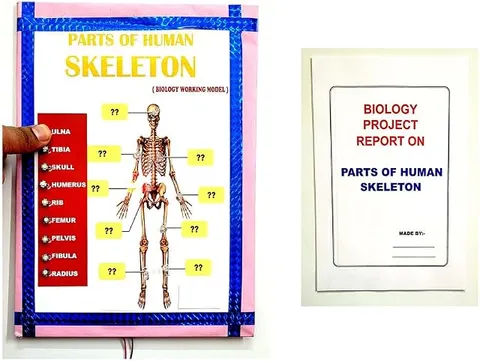
Generic Human Skeleton Kit: Skeleton Model Educational Science Project for Schools & Colleges, Biology, Ages All
Code B0DK258JLR
- Paid for and delivered by Amazon. The current price and the delivery date for your PIN code are shown there.
- Sold by Gurukul Technicals Institute, Delhi.
- Need a different topic, a custom version or a school order? Ask on WhatsApp.
In this project guide
Kit
About this kit
A human skeleton model for schools and colleges that helps students learn the major bones of the body and how they meet at joints. It is a useful study aid for biology lessons on support, protection and movement.
How it works
The science behind it
The idea the kit demonstrates, in words you can use in your report and when you explain it.
The adult human skeleton has 206 bones, though a newborn has around 300, many of which fuse as the child grows. It is divided into the axial skeleton of 80 bones, made of the skull, vertebral column, sternum and ribs, and the appendicular skeleton of 126 bones, made of the limbs and the girdles that attach them. Bones give the body shape and support, protect soft organs, as the skull protects the brain and the rib cage guards the heart and lungs, and work with muscles to produce movement. Red bone marrow makes blood cells, and bones store calcium and phosphorus. Bones meet at joints: ball and socket joints at the shoulder and hip allow movement in many directions, hinge joints at the elbow and knee move in one plane, and a pivot joint in the neck lets the head turn. Morning sunlight, which helps the body make vitamin D, and calcium from milk and curd keep bones strong.
Make it yourself
Make a hanging human skeleton model yourself
Everything you need and the order to do it in. Tick off the materials as you collect them.
What you need 9
Step by step 9 steps
Enlarge a labelled skeleton diagram to about 60 cm tall using the grid method, and trace each bone onto the board.
- Cut out the bones
The skull with a separate lower jaw, the sternum, the clavicles, the scapulae, the pelvis, and each long bone separately.
Make the backbone by threading 24 beads on the wire for the movable vertebrae: 7 for the neck, 12 for the chest and 5 for the lower back. Add a clay sacrum and coccyx at the bottom.
Cut 12 pairs of ribs and fix them to the 12 chest vertebrae at the back. At the front, fix the first seven pairs to the sternum, join pairs 8 to 10 to the rib above them, and leave the last two pairs free as floating ribs.
Join the limbs with split pins at the shoulders, elbows, wrists, hips, knees and ankles so they can move.
Fix the lower jaw to the skull with a split pin; it is the only bone of the skull that moves.
Hang the skeleton from the stand's hook by a thread through the top of the skull.
Colour the axial skeleton (skull, backbone, ribs and sternum) in one shade and the limbs and girdles in another, and add label flags.
- Add a card
An adult has 206 bones, 80 in the axial skeleton and 126 in the appendicular skeleton.
Read this first
Safety first
Go through these points before you build or switch anything on. Younger students should do this with an adult.
- Use the cutter only with an adult, on a cutting mat, cutting away from your fingers.
- Bend the legs of every split pin flat and cover them with tape so no points stick out.
- Bend over the ends of the backbone wire so they cannot scratch anyone.
- Make the stand's base wide and heavy enough that it cannot tip over onto visitors.
Troubleshooting
If something does not work
The usual problems with this kit and how to fix them. Open a problem to see the fix.
The skeleton tilts or the stand falls over
The base is too small or too light for the height. Use a wider plywood base or add a weight under it.
The arms and legs droop and swing too freely
The split pins are too loose. Put a small card washer under each pin head and press the legs down more firmly.
The backbone bends too much
The wire is too thin. Use thicker wire, or two wires twisted together, through the beads.
The proportions look wrong
Check against the diagram: the femur is the longest bone, roughly a quarter of the body's height, and the arms reach to about the middle of the thighs.
Exhibition day
How to present it
A running order for the exhibition table or the practical, step by step.
Name the bones from head to toe in order, with at least one bone from each region.
Show one example of each joint type on the skeleton and describe the movement it allows.
Explain the functions of the skeleton with an example of each, such as the skull protecting the brain.
Mention the longest bone, the femur, and the smallest, the stapes in the ear, which judges often ask about.
Practice
Viva questions
Practice questions on this kit, with short answers. Try each one aloud before you open the answer.
How many bones are there in an adult human skeleton?
There are 206 bones in the adult human skeleton.
Which is the longest bone in the human body?
The femur, or thigh bone, is the longest and strongest bone.
Give an example of a ball and socket joint.
The shoulder and hip joints are ball and socket joints, which allow movement in many directions.
How many pairs of ribs do humans have?
Humans have 12 pairs of ribs, which together with the sternum and vertebral column form the rib cage.
Project file
Project file outline
The headings of the project file, in order. Give each heading its own section and write it in your own words.
Free ebook: Writing a Science Project FileContents
- Aim: to identify the major bones of the human skeleton and the types of joints between them
- Introduction: functions of the skeleton: support, protection, movement, blood cell formation and mineral storage
- The axial skeleton: skull, vertebral column, ribs and sternum (80 bones)
- The appendicular skeleton: limbs and girdles (126 bones)
- Types of joints, with examples: ball and socket, hinge, pivot, gliding and fixed joints
- Bones and muscles: how tendons and ligaments help movement
- Construction of the model
- Bone health: calcium, vitamin D and exercise, and disorders such as arthritis and osteoporosis
- Conclusion and bibliography
Buying checklist
Before you buy
What to check before you order the kit, and what to do when it arrives.
1Before you order
- Check that the skeleton and joints are in your class syllabus and what kind of model your teacher has asked for.
- Read the listing for the model's size and whether it stands or hangs and needs any assembly.
- Practise naming the bones and joints on the model before the exhibition, and keep small parts away from young children.
- Keep the box for carrying it to school.
- Check the delivery date for your PIN code on the marketplace, and order well before the exhibition or practical.
2When it arrives
- On arrival, check the small bones of the hands and feet for missing or broken pieces.
Next steps
Take it further
Ways to turn this kit into a bigger investigation or a stronger exhibition entry.
Make models of different joint types, such as a ball and socket joint from a ping-pong ball in a cup and a hinge joint from a door hinge, and display them beside the skeleton.
Add a card comparing a newborn's skeleton (about 300 bones) with an adult's (206), and explain how bones fuse.
Show an antagonistic muscle pair, such as the biceps and triceps, using rubber bands or balloons on the arm.
Audience
Who it suits
Suits Class 6 to 12 biology lessons and exhibitions, and first-year college students revising human anatomy.
- ClassClass 10 to 12
- SubjectBiology
- TypeKit
Free to read
Free ebooks for this topic
Free PDF ebooks from Gurukul Technicals Institute on the science, the making and the presenting of projects like this one.
- Free PDF ebook
Biology Models Guide
Make the heart, lungs, kidney, eye, cell and more, and explain them well
- Free PDF ebook
Your Science Exhibition Guide
Choose a project, build it, present it and answer the judges with confidence
- Free PDF ebook
Writing a Science Project File
How to write the report, from the cover page to the bibliography
- Free PDF ebook
Viva Questions for Science Projects
How to answer examiner questions, with sample questions for popular projects