- Biology
- Ready-made model
- Class 1 to 9
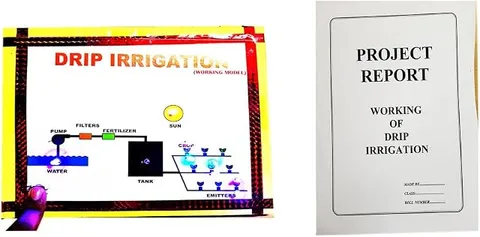
Drip Irrigation Biology Working Model Educational Science Project
Code B0BN2F2QCH
- Paid for and delivered by Amazon. The current price and the delivery date for your PIN code are shown there.
- Sold by Gurukul Technicals Institute, Delhi.
- Need a different topic, a custom version or a school order? Ask on WhatsApp.
In this project guide
Ready-made model
About this model
This working model demonstrates drip irrigation, a method of watering crops drop by drop right at their roots. It shows how farmers can save water while still growing healthy plants, an important message in a country where many regions face water shortage. It suits middle school agriculture and environment projects.
How it works
The science behind it
The idea the model demonstrates, in words you can use in your report and when you explain it.
In drip irrigation, water flows from a tank or pump through main pipes and thin lateral pipes fitted with small outlets called drippers or emitters, which release water slowly at the base of each plant. Because water goes only where the roots are, very little is lost to evaporation from open ground or to runoff. Water from a raised tank flows under gravity; the pressure at an outlet depends on the height of water above it, p = hρg, so each metre of height adds about 9.8 kPa. Once the drops reach the soil, they spread sideways and downward through the tiny spaces between soil particles. Fertiliser can be dissolved in the water and delivered along with it, which is called fertigation. Many farmers in Maharashtra and Rajasthan use drip systems for crops such as grapes, pomegranates and vegetables, and the government promotes it under the slogan 'Per Drop More Crop'.
Make it yourself
Make a drip irrigation model yourself
Build your own version from scratch, or use the steps to understand how the ready-made model is put together before you present it.
What you need 10
Step by step 9 steps
Sow the seeds or plant the seedlings in a row a week or two before the exhibition, so the model has living plants.
Cut the bottom off the bottle so it can be filled from above, make a hole in the cap, push the main tube through it and seal the joint with glue or tape so it does not leak; the bottle hangs cap-down on its stand.
Lay the lateral tube along the row of plants, fit a T-connector beside each plant, and plug the far end.
At each plant, make one tiny hole with the pushpin or fit a short tube from the T-connector down to the base of the stem, so water comes out right at the roots.
Raise the tank on its stand, fit the valve on the main tube, fill the tank and open the valve slowly until water comes out drop by drop.
If nothing flows, squeeze the tube gently to push out air bubbles, then adjust the valve so every plant gets drops at a similar rate.
Place a small cup under each outlet for five minutes and measure the water collected, to check that the drippers share it evenly.
Water the comparison tray by pouring until the surface is wet all over, measure how much water that took, and compare it with the drip tray.
Repeat the cup test with the tank raised higher and lower, to show that more height gives more pressure and more drops.
Read this first
Safety first
Go through these points before you build or switch anything on. Younger students should do this with an adult.
- Make the holes with the pushpin only with an adult, and put it away safely afterwards.
- Keep the stand steady on a flat surface so a full tank cannot topple.
- If you add a pump, keep its cells and switch on a dry shelf above the water, and switch off before touching the tubes.
- Wash your hands after handling soil or any fertiliser.
Troubleshooting
If something does not work
The usual problems with this model and how to fix them. Open a problem to see the fix.
No water comes out of the drippers
There is probably an air lock or a blocked hole. Squeeze the tube to push out bubbles, clear the holes with the pushpin, and check that the tank is higher than the plants.
The last plant gets much less water than the first
Pressure falls along the tube. Raise the tank, shorten the lateral line, or make the holes near the far end slightly bigger.
Water leaks at the joints
Push the tube fully onto each connector, wrap the joint with tape, and keep the valve partly closed so the pressure stays gentle.
The soil stays soggy
Too much water is reaching the plants. Close the valve a little so it gives slow drops rather than a trickle.
Exhibition day
How to present it
A running order for the exhibition table or the practical, step by step.
Run water through the model and show drops reaching each plant while the space between rows stays dry.
Compare drip irrigation with flood irrigation on a chart, covering water use, weeds and labour.
Explain why raising the tank increases the flow, using p = hρg.
Mention which crops in your state could benefit from drip irrigation.
Practice
Viva questions
Practice questions on this model, with short answers. Try each one aloud before you open the answer.
What is drip irrigation?
A method of irrigation in which water is supplied drop by drop at the roots of plants through pipes and emitters.
How does drip irrigation save water?
Water goes directly to the root zone, so very little is lost through evaporation, runoff or wetting the empty soil between plants.
What is fertigation?
Supplying fertiliser dissolved in irrigation water through the drip system.
Name another water-saving irrigation method.
Sprinkler irrigation, in which water is sprayed over the crop like rain through rotating nozzles.
Project file
Project file outline
The headings of the project file, in order. Give each heading its own section and write it in your own words.
Free ebook: Writing a Science Project FileContents
- Aim: to show how drip irrigation waters plants at their roots and saves water
- The need to save water in Indian agriculture
- Methods of irrigation compared: flooding, sprinklers and drip
- Parts of a drip system: tank, main line, laterals, valve and drippers
- How gravity and the height of the tank set the flow
- Materials used and construction of the model
- Experiment: water used by drip and by flood watering, with a table
- Advantages and limitations of drip irrigation
- Conclusion and sources used
Buying checklist
Before you buy
What to check before you order the model, and what to do when it arrives.
1Before you order
- Confirm that the model suits your class and your chapter on crop production or water conservation.
- Check the listing for how the model moves water; do not assume a pump or batteries are included.
- Take a towel and a bottle of water on the day, and empty the tank before carrying it.
- Keep the box so the tubes and connectors are not crushed or pulled out.
- Check the delivery date for your PIN code on the marketplace, and order well before the exhibition or practical.
- Practise explaining it. Judges ask what the model shows and why; knowing the science matters as much as the model. The viva questions above are a good place to start.
2When it arrives
- When it arrives, fill it with clean water and test it at home for leaks a few days before the exhibition.
Next steps
Take it further
Ways to turn this model into a bigger investigation or a stronger exhibition entry.
Add a simple soil moisture sensor that lights an LED when the soil is dry, to show automatic irrigation.
Dissolve a little plant food in the tank water and explain fertigation, feeding plants through the drip line.
Plot the water collected in five minutes against the tank height and discuss the pattern.
Audience
Who it suits
Class 6 to 9 science and geography exhibitions on agriculture, crop management and water conservation.
- ClassClass 1 to 9
- SubjectBiology
- TypeReady-made model
Free to read
Free ebooks for this topic
Free PDF ebooks from Gurukul Technicals Institute on the science, the making and the presenting of projects like this one.
- Free PDF ebook
Biology Models Guide
Make the heart, lungs, kidney, eye, cell and more, and explain them well
- Free PDF ebook
Your Science Exhibition Guide
Choose a project, build it, present it and answer the judges with confidence
- Free PDF ebook
Writing a Science Project File
How to write the report, from the cover page to the bibliography
- Free PDF ebook
Viva Questions for Science Projects
How to answer examiner questions, with sample questions for popular projects