- Physics
- Ready-made model
- Class 10 to 12
- Printed report included
Household Circuit or House Wiring Readymade Science Working Project & Model in Physics for School & College (with Printed Report)
Code B099R1DDJ1
- Paid for and delivered by Amazon. The current price and the delivery date for your PIN code are shown there.
- Sold by Gurukul Technicals Institute, Delhi.
- Need a different topic, a custom version or a school order? Ask on WhatsApp.
In this project guide
Ready-made model
About this model
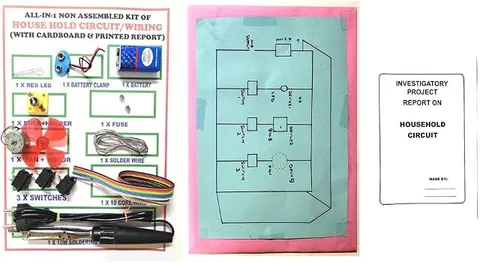
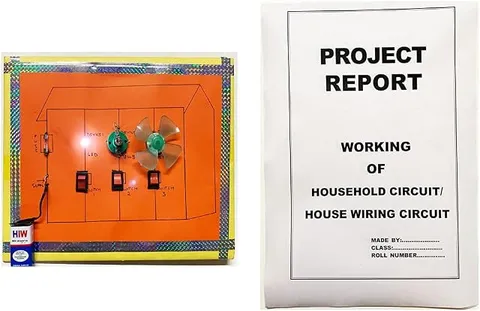
This ready-made model shows how electricity is wired in a house, with switches and loads arranged the way they are in real homes. It helps students explain house wiring and electrical safety at an exhibition without building the circuit themselves. The listing says a printed report is included.
How it works
The science behind it
The idea the model demonstrates, in words you can use in your report and when you explain it.
Electricity reaches Indian homes as 230 V AC at 50 Hz through a live wire and a neutral wire, with a third earth wire for safety. Older Indian wiring commonly uses red for live, black for neutral and green for earth. Every appliance is connected in parallel so it gets the full voltage and can be switched independently, and each switch is placed in the live wire so the appliance is fully cut off when it is switched off. A fuse or MCB protects the circuit: if too much current flows because of a short circuit or overloading, the fuse wire melts or the MCB trips. For example, a 1000 W heater on 230 V draws I = P/V, about 4.35 A. The earth wire connects the metal body of appliances such as irons and geysers to the ground, so a leakage current flows safely to earth instead of through a person.
Make it yourself
Make a house wiring model yourself
Build your own version from scratch, or use the steps to understand how the ready-made model is put together before you present it.
What you need 9
Step by step 9 steps
Draw a plan of the house showing the rooms and where each light, fan and switch will go, as in a real home.
Mount the battery pack, main switch and fuse in one corner as the 'main board'.
Run a red wire (live) and a black wire (neutral) around the house from the main board, plus a green wire to show where the earth line would run.
In each room, connect a switch in the red wire and the bulb or fan between that switch and the black wire, so every appliance is in parallel.
Fix the wires along the board with clips or glue so they look like neat house wiring, keeping bare joints apart.
Measure the total current with a multimeter with everything switched on, and choose a fuse rated a little above it.
Switch on the main switch and test each room switch. Every appliance should work without affecting the others.
- Show what the fuse does
With an adult watching, touch a wire briefly between the live and neutral lines after the fuse. The fuse should blow and cut off everything. Fit a new fuse afterwards.
Label every part (fuse, main switch, live, neutral, earth, switches) and add a chart of safety rules.
Read this first
Safety first
Go through these points before you build or switch anything on. Younger students should do this with an adult.
- The model runs only on cells; never connect it to a 230 V socket, and never open or change real house wiring, which is an electrician's job.
- Do the short-circuit fuse test only once, briefly, with an adult watching, because shorted cells can get hot.
- Cutting, screws and hot glue need adult supervision.
- Turn off the main switch before changing any wire.
Troubleshooting
If something does not work
The usual problems with this model and how to fix them. Open a problem to see the fix.
Nothing works when the main switch is on
Check the fuse first (a blown fuse has a broken wire inside), then the battery contacts and the main switch connections.
One room does not work
Check that room's switch, bulb and joints. A loose bulb in its holder is the most common cause.
Switching on the fan makes the bulbs dim
The cells are weak or the main wires are thin and long. Use fresh cells and thicker wire for the live and neutral lines.
The fuse blows as soon as I switch on
There is a short circuit, or the fuse is rated too low for the total load. Look for bare wires touching, then measure the total current and choose a slightly higher fuse.
Exhibition day
How to present it
A running order for the exhibition table or the practical, step by step.
Trace the path of current from the supply through a switch and a load and back, and show on your chart where the fuse or MCB sits.
Turn the loads on one by one to show they work independently because they are in parallel.
Explain short circuit and overloading using the fuse or MCB shown on your chart.
End with two or three home safety tips, such as never touching switches with wet hands.
Practice
Viva questions
Practice questions on this model, with short answers. Try each one aloud before you open the answer.
Why is the switch always connected in the live wire?
So that when the switch is off, the appliance is completely cut off from the high voltage and is safe to touch or repair.
What is the function of a fuse?
A fuse is a wire of low melting point that melts and breaks the circuit when the current goes above a safe value.
What is the use of the earth wire?
It connects the metal body of an appliance to the earth, so any leakage current flows to the ground and does not give a shock.
What is the difference between a short circuit and overloading?
A short circuit happens when the live and neutral wires touch directly, causing a huge current; overloading happens when appliances draw more current than the circuit is rated for.
Project file
Project file outline
The headings of the project file, in order. Give each heading its own section and write it in your own words.
The listing includes a printed project report: use this outline to check that your own file covers every part.
Free ebook: Writing a Science Project FileContents
- Aim: to show how electrical appliances are connected in a house
- Introduction: how electricity reaches our homes, and why a model must use a low-voltage battery
- Materials and the wiring diagram of the model
- Live, neutral and earth wires and their colour codes
- Why appliances are connected in parallel and why switches go in the live wire
- Fuse and MCB: how they protect against overloading and short circuits
- Procedure and observations
- Electrical safety rules at home
- Conclusion: why safe wiring matters at home, and bibliography
Buying checklist
Before you buy
What to check before you order the model, and what to do when it arrives.
1Before you order
- The listing says a printed report is included; read it, check it matches your syllabus, and add your own observations and diagram.
- Check in the listing how the model is powered and whether the battery is included.
- Be ready to explain each part yourself; teachers often ask about the fuse and the earth wire.
- Keep the box and pad the bulbs for the trip to school.
- Check the delivery date for your PIN code on the marketplace, and order well before the exhibition or practical.
2When it arrives
- Test every switch as soon as it arrives and again a few days before the exhibition.
Next steps
Take it further
Ways to turn this model into a bigger investigation or a stronger exhibition entry.
Add a two-way staircase switch circuit and explain where it is used at home.
Measure the current with one, two and three appliances on to show how the total rises, which is what overloading means.
Work out the monthly units used by real appliances at home from their wattage, using units = kilowatts × hours.
Audience
Who it suits
Suits Class 7 to 10 science exhibitions on electricity and household circuits, and works as a teaching aid for electrical safety.
- ClassClass 10 to 12
- SubjectPhysics
- TypeReady-made model
- Project reportPrinted report included
Free to read
Free ebooks for this topic
Free PDF ebooks from Gurukul Technicals Institute on the science, the making and the presenting of projects like this one.
- Free PDF ebook
Electricity and Magnetism Experiments
Hands-on experiments with cells, wires, bulbs and magnets
- Free PDF ebook
Physics Working Models Explained
Twenty classic models, how each works and how to make it
- Free PDF ebook
Your Science Exhibition Guide
Choose a project, build it, present it and answer the judges with confidence
- Free PDF ebook
Writing a Science Project File
How to write the report, from the cover page to the bibliography