- Physics
- Ready-made model
- Class 10 to 12
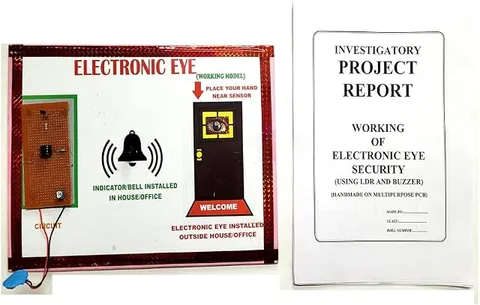
Electronic Eye Security System Physics Working Model Educational Investigatory Project
Code B0C3H4JPT3
- Paid for and delivered by Amazon. The current price and the delivery date for your PIN code are shown there.
- Sold by Gurukul Technicals Institute, Delhi.
- Need a different topic, a custom version or a school order? Ask on WhatsApp.
In this project guide
Ready-made model
About this model
This electronic eye security system uses a light sensor as its 'eye' to raise an alarm when the light around it changes. It is a classic investigatory project that shows how electronics can guard a locker, cupboard or doorway.
How it works
The science behind it
The idea the model demonstrates, in words you can use in your report and when you explain it.
The 'eye' in this kind of circuit is usually a light dependent resistor (LDR), whose resistance falls when light falls on it and rises in darkness. The LDR forms part of a voltage divider whose output controls a transistor, and the transistor switches on a buzzer, often through a latch so that the alarm keeps sounding until it is reset. In the common locker version, the sensor sits inside a dark cupboard: when someone opens the door, light falls on the LDR, its resistance drops sharply and the alarm sounds. In other versions the logic is reversed, so the alarm sounds when a shadow falls on the sensor. Either way, the circuit compares a changing light level with a set threshold, which can usually be adjusted with a variable resistor. A sensor feeding a decision circuit that drives an alarm is the heart of most security systems, from a shop's cash drawer to the strongroom of a bank.
Make it yourself
Make an electronic eye locker alarm yourself
Build your own version from scratch, or use the steps to understand how the ready-made model is put together before you present it.
What you need 10
Step by step 9 steps
- Make the light sensor
Connect the LDR from the positive line to a junction point, and the 10 kΩ preset from that junction to negative.
Connect the junction to the SCR's gate through the 1 kΩ resistor. Look up the leg order (cathode, gate, anode) for your SCR in its datasheet, as it differs between types.
Join the SCR's cathode to negative.
From the positive line, go through the push-to-break reset button to the buzzer's positive lead and to the LED's resistor. Join the buzzer's negative lead and the LED's short leg to the SCR's anode.
Switch on in a dark room, or with the LDR covered: the alarm should stay silent.
Let light fall on the LDR: the SCR fires and the buzzer sounds, and it keeps sounding even when the LDR is covered again, until you press reset.
Fix the LDR inside the locker facing the door, and set the preset so the alarm stays quiet with the door shut but sounds when it is opened in normal room light.
Mount the circuit, battery and reset button inside the locker on the hinge side, clear of the door.
Open the door ten times, slowly and quickly, in different room lighting, and record whether the alarm triggered each time.
Read this first
Safety first
Go through these points before you build or switch anything on. Younger students should do this with an adult.
- Use the soldering iron only with an adult, and keep it in its stand when not in use.
- Run the alarm only from the 9 V battery; this circuit must never be connected to a mains supply.
- Keep the buzzer at arm's length while testing, as it is loud close to the ear.
- Disconnect the battery when the model is stored, so stray light cannot set it off and drain the battery overnight.
Troubleshooting
If something does not work
The usual problems with this model and how to fix them. Open a problem to see the fix.
The buzzer sounds as soon as it is switched on, even in the dark
The preset is set too high, light is leaking into the box, or the SCR's legs are mixed up. Turn the preset down, seal gaps in the box with black tape, and check the leg order in the datasheet.
The buzzer stops as soon as the light goes
The SCR is not staying latched because too little current flows through it, or the buzzer interrupts its own current. Make sure the LED and its resistor are wired beside the buzzer to keep a steady current flowing, and check the battery.
Pressing reset does not stop the alarm
The button may be the normally open type, which does nothing here, or light is still on the LDR so the SCR fires again at once. Use a push-to-break button and close the door before pressing reset.
It does not trigger in a dimly lit room
Turn the preset up to make it more sensitive, and point the LDR towards the door gap where the most light enters.
Exhibition day
How to present it
A running order for the exhibition table or the practical, step by step.
Show the trigger: place the model in a dark box and open it, or cast a shadow on the sensor, depending on which way your model works.
Explain the chain on a chart: light sensor, voltage divider, transistor switch, alarm.
If the model has a reset, show it and explain why a latch is useful.
Discuss where such a system could protect valuables at home or in a shop.
Practice
Viva questions
Practice questions on this model, with short answers. Try each one aloud before you open the answer.
What usually acts as the 'eye' in this kind of circuit?
A light dependent resistor (LDR), whose resistance changes with the light falling on it.
In the locker version, why does the alarm sound when the door is opened?
Light enters and falls on the LDR, its resistance drops, and the change in voltage switches on the transistor and the alarm.
What is a latch in an alarm circuit?
A part of the circuit that keeps the alarm on after it has been triggered, even if the light returns to normal.
How can the sensitivity of the alarm be adjusted?
By changing a variable resistor in the voltage divider, which sets the light level at which the alarm triggers.
Project file
Project file outline
The headings of the project file, in order. Give each heading its own section and write it in your own words.
Free ebook: Writing a Science Project FileContents
- Aim: to make an alarm that sounds when light enters a closed locker
- Introduction: electronic security systems in homes, offices and banks
- The LDR as the 'eye' and the voltage divider
- How a thyristor (SCR) switches on and stays latched
- Circuit diagram and parts list
- Construction and setting the sensitivity
- Observations: trials of opening the door in different room lighting
- Limitations, such as a thief using no light, and possible improvements
- Conclusion and bibliography
Buying checklist
Before you buy
What to check before you order the model, and what to do when it arrives.
1Before you order
- Check that a sensor-and-switching project suits your class level and your teacher's brief.
- Read the listing to see whether the alarm latches, how it resets and what powers it.
- Practise a demonstration that works in a lit hall, such as a closed box opened in front of the examiner.
- Check the delivery date for your PIN code on the marketplace, and order well before the exhibition or practical.
2When it arrives
- Test it in a darkened box and in room light as soon as it arrives, because exhibition halls are bright.
- Keep the packaging so the sensor and buzzer leads arrive at school undamaged.
Next steps
Take it further
Ways to turn this model into a bigger investigation or a stronger exhibition entry.
Build the reverse version with a transistor, so the alarm sounds when a shadow falls on the LDR, and compare the two designs.
Add a 555 timer so the alarm switches itself off after a set time, and explain why real alarms do this.
Replace the LDR with a reed switch and a magnet on the door, and compare which sensor is harder to fool.
Audience
Who it suits
Class 8 to 12 students making a security or sensor-based project for an exhibition or practical.
- ClassClass 10 to 12
- SubjectPhysics
- TypeReady-made model
Free to read
Free ebooks for this topic
Free PDF ebooks from Gurukul Technicals Institute on the science, the making and the presenting of projects like this one.
- Free PDF ebook
Biology Models Guide
Make the heart, lungs, kidney, eye, cell and more, and explain them well
- Free PDF ebook
Physics Working Models Explained
Twenty classic models, how each works and how to make it
- Free PDF ebook
Investigatory Projects for Class 11 and 12
Topics, method and report structure for physics, chemistry and biology
- Free PDF ebook
Your Science Exhibition Guide
Choose a project, build it, present it and answer the judges with confidence