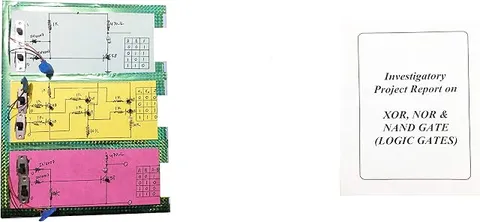
XOR,NOR & NAND Logic Gates Educational Circuit Board
Code B07NZSK4FJ
- Paid for and delivered by Amazon. The current price and the delivery date for your PIN code are shown there.
- Sold by Gurukul Technicals Institute, Delhi.
- Need a different topic, a custom version or a school order? Ask on WhatsApp.
In this project guide
Physics
About this model
An educational circuit board for three gates, XOR, NOR and NAND, which go a step beyond the basic AND, OR and NOT. It helps students explore the two universal gates and the exclusive-OR gate used for comparing bits and in binary addition.
How it works
The science behind it
The idea the model demonstrates, in words you can use in your report and when you explain it.
NAND and NOR are the universal gates. A NAND gate, Y = (A·B)', gives 0 only when both inputs are 1, and a NOR gate, Y = (A + B)', gives 1 only when both inputs are 0. Because either one alone can be wired to make NOT, AND and OR, whole digital systems can be built from a single gate type. The XOR, or exclusive-OR, gate gives 1 when exactly one input is 1: Y = A·B' + A'·B, often written A ⊕ B. It answers the question: are these two inputs different? XOR is also used to check for errors, because it can tell whether a group of bits has an odd or an even number of 1s, which is called parity. The two-way staircase switch in Indian homes behaves like an XOR, or an XNOR depending on the wiring: flipping either switch changes the state of the light, whatever the other switch is doing.
Make it yourself
Make a NAND, NOR and XOR gate board yourself
Build your own version from scratch, or use the steps to understand how the ready-made model is put together before you present it.
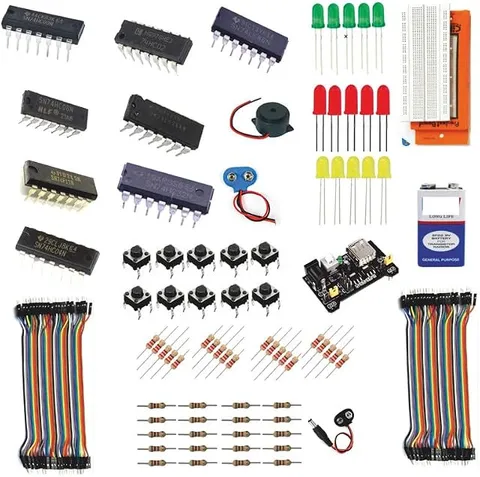
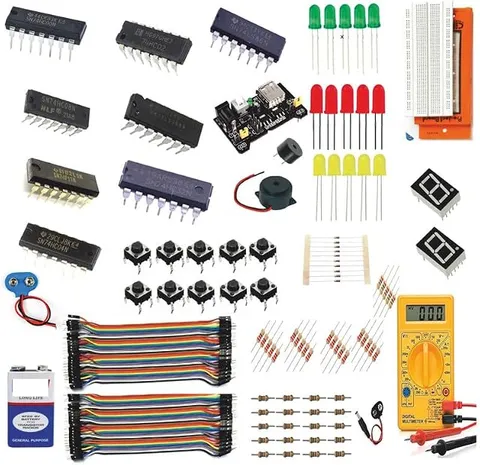
What you need 9
Step by step 9 steps
Plan three sections in a row, NAND, NOR and XOR, each with two input switches at the front and an output LED behind them.
Solder the three sockets. On each, connect pin 14 to positive and pin 7 to negative, with a 0.1 µF capacitor between them.
Wire each input switch to connect its line to positive, with a 10 kΩ resistor holding the line at negative when the switch is off, and a red LED with 330 Ω showing when it is 1.
- NAND
Take the inputs to pins 1 and 2 of the 74HC00, and pin 3 through a green LED and 330 Ω to negative.
- NOR
The 74HC02 is laid out differently. Its first gate has inputs on pins 2 and 3 and its output on pin 1.
- XOR
Take the inputs to pins 1 and 2 of the 74HC86 and the output from pin 3.
On each chip, connect the inputs of the three unused gates to negative, because CMOS inputs must never be left floating.
Fit the chips with their notches matching the sockets, switch on, and try all four input combinations on each section to fill in the truth tables.
Beside the board, wire two two-way switches as a staircase circuit with an LED. Label the positions 0 and 1 so the LED lights only when the switches differ: that is XOR. If it lights when they match, you have made XNOR; swap the two wires between the switches.
Read this first
Safety first
Go through these points before you build or switch anything on. Younger students should do this with an adult.
- Use only three AA cells; these chips work only up to about 6 V, so a 9 V battery connected directly would damage them.
- Fit the chips with the power off and the notch the right way round; a reversed chip can get hot enough to burn.
- Solder only with an adult present, and keep the iron in its stand.
- Check for solder bridges between neighbouring pins before switching on for the first time.
Troubleshooting
If something does not work
The usual problems with this model and how to fix them. Open a problem to see the fix.
The NOR output never changes
It was probably wired like the NAND chip. On the 74HC02, the first gate's output is pin 1 and its inputs are pins 2 and 3.
An output flickers or changes when your hand comes near
An input is floating. Check the 10 kΩ resistor on each input switch, and that the unused gate inputs are connected to negative.
A chip gets warm
It may be fitted backwards, or there may be a solder bridge between pins 14 and 7. Switch off and check.
The XOR output lights when both inputs are 1
The chip may be an OR chip (74HC32) by mistake. Read the number printed on top of the chip.
Exhibition day
How to present it
A running order for the exhibition table or the practical, step by step.
Demonstrate the staircase switch idea with the XOR gate: change one input at a time and show the output flipping.
Write the truth tables of all three gates on one chart so the differences stand out.
Explain why NAND and NOR are called universal, and show on paper how an AND gate can be made from NAND gates.
Prepare the Boolean expression for each gate, including A ⊕ B for XOR.
Practice
Viva questions
Practice questions on this model, with short answers. Try each one aloud before you open the answer.
When is the output of an XOR gate 1?
When its two inputs are different, that is, one is 1 and the other is 0.
Write the Boolean expression for a NOR gate.
Y = (A + B)', the complement of A OR B.
How does a two-way staircase switch relate to XOR?
Changing either switch flips the light, just as changing either input of an XOR gate flips its output.
What is a parity check?
It is a simple error check that uses XOR to find whether the number of 1s in a group of bits is odd or even.
Project file
Project file outline
The headings of the project file, in order. Give each heading its own section and write it in your own words.
Free ebook: Writing a Science Project FileContents
- Aim: to verify the truth tables of the NAND, NOR and XOR gates
- Introduction: why NAND and NOR are called universal gates
- NAND gate: symbol, Y = (A·B)' and truth table
- NOR gate: symbol, Y = (A + B)' and truth table
- XOR gate: symbol, Y = A·B' + A'·B and truth table
- Circuit diagram of the board with the IC pin connections
- Observations for every input combination
- XOR in everyday life: the staircase switch and parity checking
- Conclusion and bibliography
Buying checklist
Before you buy
What to check before you order the model, and what to do when it arrives.
1Before you order
- Check which gates your syllabus or teacher expects; if the basic AND, OR and NOT gates are also needed, you may need a second board.
- Read the listing to see how the board is powered and whether batteries are mentioned.
- Keep spare cells and the box for the exhibition day.
- Check the delivery date for your PIN code on the marketplace, and order well before the exhibition or practical.
- Practise explaining it. Judges ask what the model shows and why; knowing the science matters as much as the model. The viva questions above are a good place to start.
2When it arrives
- When it arrives, try all four input combinations on each gate and write the truth tables yourself.
Next steps
Take it further
Ways to turn this model into a bigger investigation or a stronger exhibition entry.
On a breadboard, make NOT, AND and OR gates using only NAND gates to prove that NAND is universal.
Make a half adder with the XOR gate for the Sum and an AND gate (a NAND followed by a NOT) for the Carry.
Make a 3-bit parity checker from two XOR gates that lights when an odd number of switches are on.
Audience
Who it suits
Suits Class 11 and 12 physics investigatory projects and computer science students studying Boolean logic beyond the basic gates.
- SubjectPhysics
Free to read
Free ebooks for this topic
Free PDF ebooks from Gurukul Technicals Institute on the science, the making and the presenting of projects like this one.
- Free PDF ebook
Electricity and Magnetism Experiments
Hands-on experiments with cells, wires, bulbs and magnets
- Free PDF ebook
Physics Working Models Explained
Twenty classic models, how each works and how to make it
- Free PDF ebook
Your Science Exhibition Guide
Choose a project, build it, present it and answer the judges with confidence