61% off
- Maths
- Ready-made model
- Class 1 to 9
- Report shown in the photo
Types of Polygon Using LEDs Mathematics Working Project Model CBSE Kit
Code B0HLXZ5JTF
- Paid for and delivered by Amazon. The current price and the delivery date for your PIN code are shown there.
- Sold by Gurukul Technicals Institute, Delhi.
- Need a different topic, a custom version or a school order? Ask on WhatsApp.
In this project guide
Ready-made model
About this model
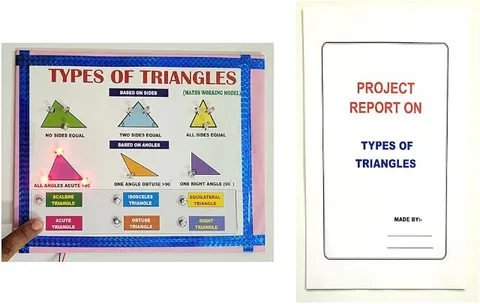
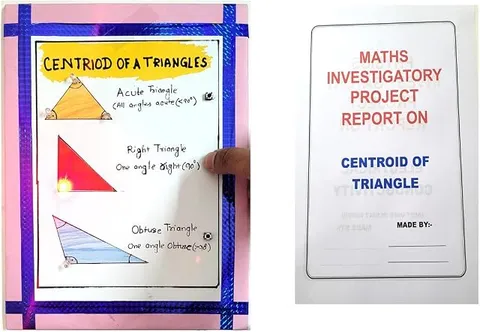
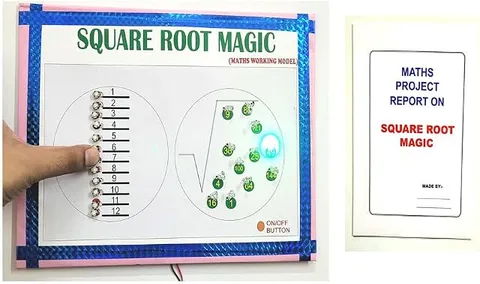
This maths working model explains eight polygons on a chart titled Types of Polygons, set on a pink board with a blue star border. As shown in the photo, the triangle, quadrilateral, pentagon, hexagon, heptagon, octagon, nonagon and decagon each sit in their own box with three facts: the number of sides and vertices, the number of diagonals and the sum of the interior angles. LEDs sit at the corners of every shape, and pressing the small red button beside a shape lights its corners. A printed report cover is also shown.
How it works
The science behind it
The idea the model demonstrates, in words you can use in your report and when you explain it.
A polygon is a simple closed figure made only of line segments. It is named by its number of sides, n, and it has as many vertices as sides. A diagonal joins two vertices that are not next to each other. From one vertex you can draw (n - 3) diagonals, and counting from every vertex counts each diagonal twice, so a polygon has n(n - 3)/2 diagonals: none for a triangle, 9 for a hexagon and 35 for a decagon. In a convex polygon, the diagonals from one vertex split it into (n - 2) triangles, and the angles of each triangle add up to 180°, so the interior angles add up to (n - 2) × 180°. In a regular polygon all sides and all angles are equal, so each interior angle is (n - 2) × 180° ÷ n, which is 120° for a regular hexagon. The exterior angles of any convex polygon add up to 360°. Honeycomb cells are hexagons, and a STOP sign is an octagon.
Make it yourself
Make a types of polygons board with push-button lights yourself
Build your own version from scratch, or use the steps to understand how the ready-made model is put together before you present it.
What you need 8
Step by step 8 steps
Divide the chart into eight boxes and write the title Types of Polygons across the top.
In each box draw one polygon, from a triangle to a decagon. For a regular shape, draw a light circle with the compass and mark n points on it 360° ÷ n apart, then join them.
Beside each shape write three facts: its number of sides and vertices, its diagonals from n(n - 3)/2, and its angle sum from (n - 2) × 180°. Check every figure twice.
Make a small hole at every corner and push an LED through from the front, so its legs come out at the back.
Fix a push button beside each shape's name.
At the back, connect each LED's long leg through its own resistor to one terminal of that shape's button, and join the other terminal of all eight buttons to the battery positive through the switch.
Join every LED's short leg to one common wire going to the battery negative.
Press each button and check that only that shape's corners light, then tape the wiring flat and add the border.
Read this first
Safety first
Go through these points before you build or switch anything on. Younger students should do this with an adult.
- Never short the battery terminals together, and unclip the battery when the board is not on show.
- Keep a resistor in series with every LED, or it can burn out at once.
- Solder only with an adult, keep the hot iron on its stand and work in a room with fresh air.
- Use the compass point, the hole-making tool and any cutter carefully, and tape over sharp wire ends at the back.
Troubleshooting
If something does not work
The usual problems with this model and how to fix them. Open a problem to see the fix.
Pressing a button lights nothing
Many four-legged push buttons have pairs of legs that are always joined. Use two diagonally opposite legs, and check the switch and the battery.
One corner LED stays dark
It may be in backwards or its resistor joint may be loose. The long leg must go towards the button side.
The corners of two shapes light together
Two button wires are touching at the back. Separate them and tape every joint.
The decagon's lights are dimmer than the triangle's
Ten LEDs draw more current than three, so a weak battery shows it there first. Fit a fresh battery before the exhibition.
Exhibition day
How to present it
A running order for the exhibition table or the practical, step by step.
Press the buttons in order from triangle to decagon and show the lit corners growing as the number of sides grows.
Write n(n - 3)/2 and (n - 2) × 180° on a side chart and use them to check two boxes on the board.
Draw a hexagon on paper, join one vertex to the others to make four triangles, and show why its angles add up to 720°.
Show polygons from daily life, such as a hexagonal nut, a honeycomb picture and an octagonal STOP sign.
Practice
Viva questions
Practice questions on this model, with short answers. Try each one aloud before you open the answer.
What is a diagonal of a polygon?
It is a line segment joining two vertices of the polygon that are not next to each other.
How many diagonals does an octagon have?
20, because n(n - 3)/2 = 8 × 5 ÷ 2 = 20.
What is the sum of the interior angles of a heptagon?
(7 - 2) × 180° = 900°, as written in its box on the board.
What is the sum of the exterior angles of a convex polygon?
It is always 360°, whatever the number of sides.
Project file
Project file outline
The headings of the project file, in order. Give each heading its own section and write it in your own words.
The listing photo shows a printed project report: if it comes with your order, use this outline to check that your own file covers every part.
Free ebook: Writing a Science Project FileContents
- Aim: to show the types of polygons and their sides, diagonals and angle sums
- Introduction: what a polygon is, and convex and concave polygons
- Naming polygons by the number of sides, from triangle to decagon
- Diagonals and the formula n(n - 3)/2
- Sum of interior angles, (n - 2) × 180°, and the exterior angle sum of 360°
- Regular polygons and the size of each interior angle
- Construction of the board and its push-button LED circuit
- Polygons in daily life and in nature
- Conclusion and bibliography
Buying checklist
Before you buy
What to check before you order the model, and what to do when it arrives.
1Before you order
- Check that polygons and angle sums are in your class syllabus and what your teacher wants explained.
- Find out how the lights are powered and keep a spare battery of that type for the exhibition day.
- Keep the box and carry the board flat so the LEDs and wires at the back are not bent.
- Check the delivery date for your PIN code on the marketplace, and order well before the exhibition or practical.
2When it arrives
- Check what arrives against the photo: the chart, the buttons and the lights. The photo also shows a printed report cover, so confirm it comes with your order if you need one.
- Press every button soon after it arrives and note any corner light that does not glow.
Next steps
Take it further
Ways to turn this model into a bigger investigation or a stronger exhibition entry.
Add a box for a dodecagon, with 12 sides, and work out its 54 diagonals and its 1800° angle sum.
Cut paper polygons, tear off their corners and lay them side by side to show the angle sum.
Show which regular polygons tile a floor without gaps: triangles, squares and hexagons, because their interior angles divide 360° exactly.
Audience
Who it suits
Suits Class 6 to 9 maths exhibitions and lab activities on polygons and angle sums, and quick revision of the diagonal and angle-sum formulas before a viva.
- ClassClass 1 to 9
- SubjectMaths
- TypeReady-made model
- Project reportShown in the listing photo
Free to read
Free ebooks for this topic
Free PDF ebooks from Gurukul Technicals Institute on the science, the making and the presenting of projects like this one.
- Free PDF ebook
Maths Working Models and Activities
Make maths visible: models for number, geometry, algebra and data
- Free PDF ebook
Electricity and Magnetism Experiments
Hands-on experiments with cells, wires, bulbs and magnets
- Free PDF ebook
Your Science Exhibition Guide
Choose a project, build it, present it and answer the judges with confidence
- Free PDF ebook
Writing a Science Project File
How to write the report, from the cover page to the bibliography