- Physics
- Ready-made model
- Class 1 to 9
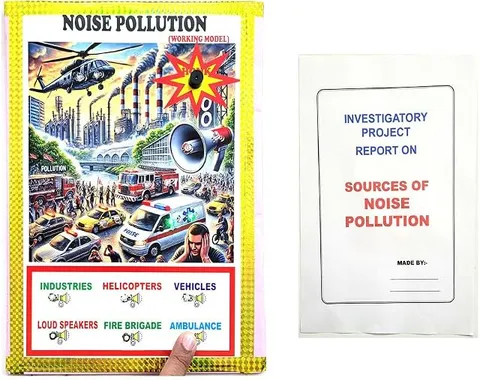
Sources of Noise Pollution Working Model Project and Science Aid Educational Electronic Hobby Kit
Code B0DTYNX5VG
- Paid for and delivered by Amazon. The current price and the delivery date for your PIN code are shown there.
- Sold by Gurukul Technicals Institute, Delhi.
- Need a different topic, a custom version or a school order? Ask on WhatsApp.
In this project guide
Ready-made model
About this model
This model covers the sources of noise pollution in daily life, a topic that takes in traffic, loudspeakers, construction sites and factories. It helps students explain what noise pollution is, how it harms health and what each of us can do to reduce it.
How it works
The science behind it
The idea the model demonstrates, in words you can use in your report and when you explain it.
Sound is produced by vibrating objects and travels through air as a longitudinal wave. Noise is unwanted or unpleasant sound, and noise pollution is excessive noise that harms health or disturbs daily life. Loudness is measured in decibels (dB) on a logarithmic scale: every rise of 10 dB means the sound intensity is ten times greater. Normal conversation is around 60 dB, while busy traffic can cross 80 dB, and long exposure to very loud sound can permanently damage hearing. Noise also causes stress, headaches, poor sleep and difficulty in concentrating. In India, common sources include vehicle horns, loudspeakers, construction machines, generators, factories and firecrackers. The Noise Pollution (Regulation and Control) Rules, 2000 set separate day and night limits for industrial, commercial and residential areas, and declare silence zones around hospitals, schools and courts. Planting trees, honking only when needed and keeping volumes low all help.
Make it yourself
Make a noise pollution sources model yourself
Build your own version from scratch, or use the steps to understand how the ready-made model is put together before you present it.
What you need 8
Step by step 7 steps
- Lay out the town
A road with vehicles, a factory, a loudspeaker on a pole and a construction site, with a hospital and a school set back behind a green belt.
Fix one buzzer and one LED with its resistor beside each noisy source.
Wire each buzzer and LED pair through its own push button to the battery, so every source can be switched on separately.
Run the wires under the base and bring all the buttons to one control strip at the front, each labelled with its source.
Put the 'Silence Zone' sign near the hospital and school, and plant the green belt between them and the road.
Press the buttons one at a time and then together, to show how noise builds up in a busy place.
Beside each source, add a card with how loud it usually is (quiet, moderate or harmful) and one way to reduce it, such as no honking or fixed loudspeaker hours.
Read this first
Safety first
Go through these points before you build or switch anything on. Younger students should do this with an adult.
- Buzzers can be piercing at close range; point them away from ears and do not hold the buttons down for long.
- Use only cells or the 9 V battery, and disconnect it after the demonstration.
- Use the glue gun and any cutter only with an adult.
- Keep toy vehicles and small parts away from younger children.
Troubleshooting
If something does not work
The usual problems with this model and how to fix them. Open a problem to see the fix.
One buzzer does not sound
Check its polarity, as most small buzzers have a red positive lead, then check its button and joints.
All the buzzers sound weak when pressed together
The battery cannot supply them all at once. Use a fresh battery or a pack of AA cells.
A buzzer sounds without its button being pressed
Two wires are touching under the base. Insulate every joint with tape or heat-shrink sleeving.
Exhibition day
How to present it
A running order for the exhibition table or the practical, step by step.
Group the sources on your model into transport, industry, construction and social events.
Use a sound meter app on a phone to measure the noise near your stall, and say that app readings are approximate.
Explain the decibel scale with two or three everyday examples.
End with simple actions: no unnecessary honking, lower volumes, and trees planted as sound barriers.
Practice
Viva questions
Practice questions on this model, with short answers. Try each one aloud before you open the answer.
What is noise pollution?
It is the presence of unwanted, excessive sound in the environment that harms health or disturbs people.
In which unit is loudness measured?
In decibels (dB).
Name three harmful effects of noise pollution.
Hearing loss, stress and lack of sleep.
How can noise pollution be reduced?
By avoiding unnecessary horns, keeping loudspeaker volumes low, fitting silencers on machines and planting trees along roads.
Project file
Project file outline
The headings of the project file, in order. Give each heading its own section and write it in your own words.
Free ebook: Writing a Science Project FileContents
- Aim: to show the main sources of noise pollution in a town and how to reduce them
- What sound is and how loudness is measured in decibels
- Sources of noise: traffic, industry, loudspeakers and construction
- Effects on health: hearing loss, stress, poor sleep and poor concentration
- Noise rules in India and silence zones near hospitals and schools
- Survey: noise levels around your school or home at different times of day
- Ways to control noise: green belts, silencers and no-honking drives
- Conclusion: steps our school can take against noise, and sources
Buying checklist
Before you buy
What to check before you order the model, and what to do when it arrives.
1Before you order
- Check the class level and whether the listing describes sounds, lights or both, so it suits your presentation.
- See whether the listing mentions batteries, and buy spares for a full exhibition day.
- Ask your teacher whether a model that makes noise is fine in a crowded hall; you may need to run it in short bursts.
- Keep the box, and pack the small toy models separately.
- Check the delivery date for your PIN code on the marketplace, and order well before the exhibition or practical.
- Practise explaining it. Judges ask what the model shows and why; knowing the science matters as much as the model. The viva questions above are a good place to start.
2When it arrives
- Try every button when it arrives and again a few days before the exhibition.
Next steps
Take it further
Ways to turn this model into a bigger investigation or a stronger exhibition entry.
Measure noise around your school with a phone sound meter app at different times, noting that app readings are only approximate.
Add a sound sensor module with LEDs that light up in steps as the noise rises.
Put a buzzer inside a box lined with cardboard, cloth, foam or egg trays in turn and compare how much each material cuts the sound.
Audience
Who it suits
Suits Class 6 to 9 science and environmental studies projects on sound and pollution.
- ClassClass 1 to 9
- SubjectPhysics
- TypeReady-made model
Free to read
Free ebooks for this topic
Free PDF ebooks from Gurukul Technicals Institute on the science, the making and the presenting of projects like this one.
- Free PDF ebook
Physics Working Models Explained
Twenty classic models, how each works and how to make it
- Free PDF ebook
Your Science Exhibition Guide
Choose a project, build it, present it and answer the judges with confidence
- Free PDF ebook
Writing a Science Project File
How to write the report, from the cover page to the bibliography
- Free PDF ebook
Viva Questions for Science Projects
How to answer examiner questions, with sample questions for popular projects