- Physics
- Ready-made model
Production Of Induced Emf&Magnetic Flux Using Voltmeter Physics Working Model Educational Science Project, Multicolor
Code B0C3H3XK1N
- Paid for and delivered by Amazon. The current price and the delivery date for your PIN code are shown there.
- Sold by Gurukul Technicals Institute, Delhi.
- Need a different topic, a custom version or a school order? Ask on WhatsApp.
In this project guide
Ready-made model
About this model
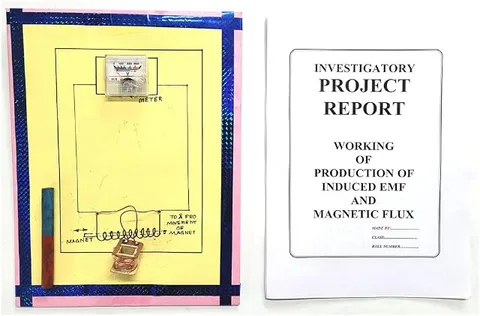
A physics working model that shows how moving a magnet near a coil produces an induced EMF, read on a voltmeter. It is a hands-on demonstration of Faraday's laws of electromagnetic induction, the principle behind every electric generator.
How it works
The science behind it
The idea the model demonstrates, in words you can use in your report and when you explain it.
Magnetic flux, Φ, measures how much magnetic field passes through a coil: Φ = BA cos θ, where θ is the angle between the field B and the normal to the coil of area A. Its SI unit is the weber (Wb), equal to one tesla square metre. Faraday's law says that whenever the flux through a coil changes, an EMF is induced in it, equal to the rate of change of flux. For a coil of N turns, e = −N dΦ/dt. The minus sign stands for Lenz's law: the induced current flows in a direction that opposes the change producing it. So moving the magnet faster, using a stronger magnet or adding more turns gives a bigger reading, while holding the magnet still gives zero. Reversing the motion reverses the direction of the EMF. Old Indian bicycles often had a dynamo lamp that glowed brighter the faster you pedalled.
Make it yourself
Make an induced EMF demonstration with a coil and magnet yourself
Build your own version from scratch, or use the steps to understand how the ready-made model is put together before you present it.
What you need 9
Step by step 9 steps
Glue a card disc near each end of the tube to make a bobbin, leaving a few centimetres of tube free at both ends.
Wind 300 to 500 neat turns, all in the same direction, counting in hundreds, and leave about 15 cm of wire free at each end. Tape over the winding.
Scrape the enamel off the last 1 to 2 cm of both wire ends until the copper is bright, and check with the multimeter that the coil conducts.
Fix the coil lying flat on the base and connect its ends through the terminals to the meter.
Use the compass to find the magnet's north pole and mark it.
Push the north pole quickly into the coil: the meter swings one way. Hold the magnet still inside: the reading falls to zero. Pull it out: the meter swings the other way.
Repeat with the south pole, then slowly and quickly, and note the size and direction of each reading.
Keep the magnet still and move the coil over it instead: you get the same effect, because only the relative motion matters.
Record the largest reading for slow, medium and fast pushes in a table.
Read this first
Safety first
Go through these points before you build or switch anything on. Younger students should do this with an adult.
- Strong magnets snap together hard and can pinch skin or chip. Keep them apart, and away from young children, because swallowed magnets are very dangerous.
- Keep the magnets away from phones, bank cards and the meter itself.
- Never connect the coil or the meter's millivolt range to a battery or any supply; a battery across a galvanometer can damage it.
- The thin wire ends are sharp, so handle them carefully and tape them down.
Troubleshooting
If something does not work
The usual problems with this model and how to fix them. Open a problem to see the fix.
The meter does not move at all
The enamel may not be fully scraped off, the wire may be broken, or the meter may be on too high a range. Check the coil's continuity and use the lowest range.
The reading is very small
Use more turns, a stronger magnet and a faster push. The EMF depends on how fast the flux changes.
The digital meter's numbers flicker and are hard to read
A digital meter samples too slowly to catch a quick pulse. Use a centre-zero galvanometer, or your meter's maximum-hold setting if it has one.
The meter swings both ways during one push
The magnet is passing right through the coil, so the flux rises and then falls. Stop the magnet in the middle of the coil to see one clear swing.
Exhibition day
How to present it
A running order for the exhibition table or the practical, step by step.
Move the magnet in and out at different speeds and show that the reading grows with speed.
Hold the magnet still inside the coil and point out that the reading falls to zero: only a changing flux induces an EMF.
Show that pushing the magnet in and pulling it out give EMFs in opposite directions, and link this to Lenz's law.
Write e = −N dΦ/dt on a card and explain each symbol in one line.
Practice
Viva questions
Practice questions on this model, with short answers. Try each one aloud before you open the answer.
What is magnetic flux, and what is its SI unit?
Magnetic flux is the amount of magnetic field passing through an area, Φ = BA cos θ, and its SI unit is the weber.
State Faraday's law of electromagnetic induction.
The EMF induced in a coil equals the rate of change of magnetic flux through it, multiplied by the number of turns.
Why is there no reading when the magnet is held still?
The flux through the coil is not changing, so no EMF is induced, however strong the magnet is.
What does Lenz's law state?
The induced current always flows in a direction that opposes the change in flux that produced it.
Project file
Project file outline
The headings of the project file, in order. Give each heading its own section and write it in your own words.
Free ebook: Writing a Science Project FileContents
- Aim: to show that a changing magnetic flux through a coil induces an EMF
- Introduction: Michael Faraday's experiments on electromagnetic induction in 1831
- Magnetic flux, Φ = BA cos θ, and its unit, the weber
- Faraday's laws and Lenz's law: e = −N dΦ/dt
- Construction of the coil and the set-up
- Observations: direction and size of the deflection for each pole, in and out, slow and fast
- Factors affecting the induced EMF: speed, magnet strength and number of turns
- Applications: generators, transformers, induction cooktops and metal detectors
- Conclusion and bibliography
Buying checklist
Before you buy
What to check before you order the model, and what to do when it arrives.
1Before you order
- Check that electromagnetic induction is in your syllabus and what your teacher expects from the project.
- Read the listing to see what kind of meter the model uses, because the induced EMF from a hand-moved magnet is small.
- Carry the magnet separately, away from phones and cards, and keep the box for transport.
- Check the delivery date for your PIN code on the marketplace, and order well before the exhibition or practical.
- Practise explaining it. Judges ask what the model shows and why; knowing the science matters as much as the model. The viva questions above are a good place to start.
2When it arrives
- Try it as soon as it arrives; if it has a digital meter, check that the meter's battery works.
Next steps
Take it further
Ways to turn this model into a bigger investigation or a stronger exhibition entry.
Tap the coil at 100, 200, 300 and 400 turns and plot the induced EMF against the number of turns.
Drop a strong magnet through a copper pipe and time its fall, to show Lenz's law slowing it down without any contact.
Wind a 1,000-turn coil and use it to flash two LEDs joined facing opposite ways: one flashes as the magnet goes in, the other as it comes out.
Audience
Who it suits
Suits Class 10 to 12 physics exhibitions, practicals and investigatory projects on electromagnetic induction.
- SubjectPhysics
- TypeReady-made model
Free to read
Free ebooks for this topic
Free PDF ebooks from Gurukul Technicals Institute on the science, the making and the presenting of projects like this one.
- Free PDF ebook
Electricity and Magnetism Experiments
Hands-on experiments with cells, wires, bulbs and magnets
- Free PDF ebook
Physics Working Models Explained
Twenty classic models, how each works and how to make it
- Free PDF ebook
Your Science Exhibition Guide
Choose a project, build it, present it and answer the judges with confidence
- Free PDF ebook
Writing a Science Project File
How to write the report, from the cover page to the bibliography