- Physics
- Ready-made model
Magnetic Brake Project
Code B0G2THL6XY
- Paid for and delivered by Amazon. The current price and the delivery date for your PIN code are shown there.
- Sold by Gurukul Technicals Institute, Delhi.
- Need a different topic, a custom version or a school order? Ask on WhatsApp.
In this project guide
Ready-made model
About this model
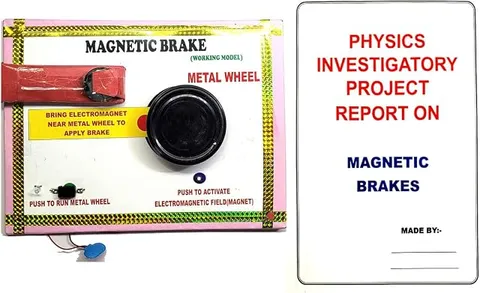
This physics project demonstrates eddy current braking, in which a moving metal part is slowed down by a magnet without any rubbing contact. It is a clear way to show electromagnetic induction and Lenz's law at work in a real braking system.
What the listing says
- Eddy Current Braking System Physics Working Project
How it works
The science behind it
The idea the model demonstrates, in words you can use in your report and when you explain it.
When a conductor such as an aluminium or copper disc moves through a magnetic field, the magnetic flux through each part of it keeps changing. By Faraday's law, this induces small circulating currents inside the metal, called eddy currents. By Lenz's law, these currents flow in a direction that opposes the change producing them, so they set up a magnetic force that resists the motion. The kinetic energy of the moving part turns into heat in the metal, so it slows down without any brake pads wearing out. The braking force is larger at higher speed and becomes very small as the part slows, so eddy current brakes are paired with ordinary friction brakes to bring a vehicle to a complete stop. The older electricity meters in Indian homes, with a spinning aluminium disc, used a permanent magnet in exactly this way to control the speed of the disc.
Make it yourself
Make an eddy current magnetic brake yourself
Build your own version from scratch, or use the steps to understand how the ready-made model is put together before you present it.
What you need 9
Step by step 8 steps
Fix the motor firmly on the base with clamps or glue so its shaft points straight up or straight out.
Glue the hub exactly at the centre of the aluminium disc and press it onto the motor shaft so the disc spins without wobbling.
Fix the magnets at the end of the wooden lever so that when lowered they sit close to the edge of the disc, on one or both sides, without touching it.
Wire the motor to the cell holder through the switch. Spin the disc, switch off, and time how long it takes to stop on its own.
Spin it again, switch off, and immediately lower the magnet lever. Time how long it takes to stop now.
Repeat with different gaps between magnet and disc and with more magnets, recording each stopping time.
Swap in the plastic disc and show that the magnets now have no braking effect, because plastic does not conduct.
Ask an adult to cut a few slots from the edge towards the centre of a second aluminium disc, and show that the braking becomes weaker because the eddy currents are broken up.
Read this first
Safety first
Go through these points before you build or switch anything on. Younger students should do this with an adult.
- Neodymium magnets snap together very hard and can pinch skin or chip; handle one at a time and keep them away from phones, cards and anyone with a pacemaker.
- Cut aluminium edges are sharp: an adult should cut and file the disc and tape over the edge.
- Keep fingers, hair and loose sleeves away from the spinning disc, and never stop it with your hand.
- Use the hot glue gun only with an adult and let joints cool before touching.
- Keep magnets away from young children; swallowed magnets are very dangerous.
Troubleshooting
If something does not work
The usual problems with this model and how to fix them. Open a problem to see the fix.
The magnet sticks to the disc
The disc is steel or tin-plated steel, not aluminium. Use a real aluminium or copper disc, which a magnet does not attract.
There is no noticeable braking
The magnets may be weak, the gap too large or the disc too thin. Use stronger magnets, bring them closer, or place magnets on both sides with opposite poles facing each other across the disc.
The disc wobbles and hits the magnets
The hub is not centred or not square to the disc. Re-fix it carefully and increase the gap slightly until it spins true.
The motor spins the disc only slowly
The disc may be too heavy for the motor or the cells may be weak. Use a lighter disc, fresh cells or one more cell, staying within the motor's rating.
Exhibition day
How to present it
A running order for the exhibition table or the practical, step by step.
If the magnet can be moved, compare how quickly the moving part stops with the magnet close by and with it far away.
Explain why a plastic disc would not slow down, since it cannot carry eddy currents.
Name real uses such as train brakes, exercise cycles and the damping in moving-coil meters.
Point out that the energy is not destroyed but turns into heat in the metal.
Practice
Viva questions
Practice questions on this model, with short answers. Try each one aloud before you open the answer.
What are eddy currents?
They are loops of induced current set up inside a solid conductor when the magnetic flux through it changes.
Which law gives the direction of eddy currents?
Lenz's law: the induced current always opposes the change in flux that causes it, which is why it resists the motion.
Why can't an eddy current brake alone bring a vehicle to a complete stop?
The braking force depends on speed, so it becomes almost zero as the vehicle slows down, and a friction brake is needed to finish the stop.
How are eddy currents reduced in a transformer core?
By making the core from thin laminated sheets insulated from each other, which breaks up the current loops.
Project file
Project file outline
The headings of the project file, in order. Give each heading its own section and write it in your own words.
Free ebook: Writing a Science Project FileContents
- Aim: to demonstrate eddy current braking of a spinning aluminium disc
- Introduction: electromagnetic induction, Faraday's law and Lenz's law
- How eddy currents produce a braking force without contact
- Materials and construction of the model
- Procedure: timing the disc with and without the magnets
- Observations: stopping time for different gaps and numbers of magnets
- Effect of slots in the disc and of a non-conducting disc
- Applications: braking in some trains and rides, exercise bikes and older electricity meters
- Conclusion
Buying checklist
Before you buy
What to check before you order the model, and what to do when it arrives.
1Before you order
- Check that electromagnetic induction is in your syllabus or that your teacher has approved this topic.
- Read the listing to see what is mentioned with the model, such as batteries or a report.
- Store and carry it with the magnets kept away from phones and bank cards.
- Keep the box and padding so the disc does not bend in transit.
- Check the delivery date for your PIN code on the marketplace, and order well before the exhibition or practical.
- Practise explaining it. Judges ask what the model shows and why; knowing the science matters as much as the model. The viva questions above are a good place to start.
2When it arrives
- Try the model as soon as it arrives and again a few days before the exhibition, to make sure the disc spins freely.
Next steps
Take it further
Ways to turn this model into a bigger investigation or a stronger exhibition entry.
Drop a strong magnet through a copper or aluminium pipe and through a plastic pipe of the same length, and compare the fall times.
Measure stopping time at different starting speeds and explain why eddy braking fades at low speed, so real vehicles also need friction brakes.
Build a pendulum version with an aluminium plate swinging between magnets and count how many swings it makes with and without them.
Audience
Who it suits
Suits Class 12 physics investigatory projects on electromagnetic induction and engineering students exploring braking systems.
- SubjectPhysics
- TypeReady-made model
Free to read
Free ebooks for this topic
Free PDF ebooks from Gurukul Technicals Institute on the science, the making and the presenting of projects like this one.
- Free PDF ebook
Electricity and Magnetism Experiments
Hands-on experiments with cells, wires, bulbs and magnets
- Free PDF ebook
Physics Working Models Explained
Twenty classic models, how each works and how to make it
- Free PDF ebook
Your Science Exhibition Guide
Choose a project, build it, present it and answer the judges with confidence
- Free PDF ebook
Writing a Science Project File
How to write the report, from the cover page to the bibliography