- Physics
- Ready-made model
- Class 10 to 12
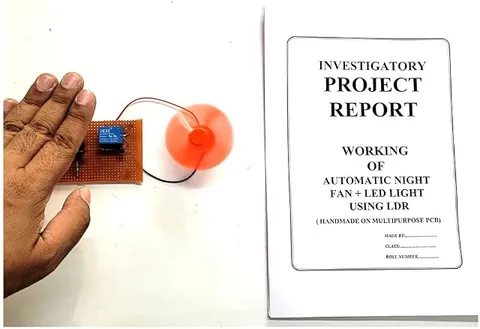
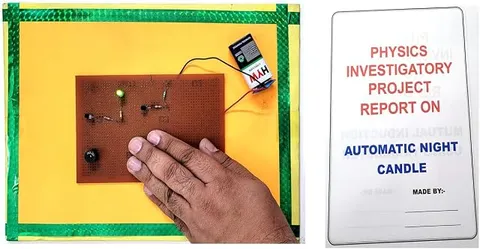
Light Dependent Resistance Based Automatic Night Light or Candle Physics Investigatory Project Model
Code B0G2TD4TMD
- Paid for and delivered by Amazon. The current price and the delivery date for your PIN code are shown there.
- Sold by Gurukul Technicals Institute, Delhi.
- Need a different topic, a custom version or a school order? Ask on WhatsApp.
In this project guide
Ready-made model
About this model
This investigatory model uses a light dependent resistance (LDR) to switch on a night light or electronic candle automatically in the dark. It is a good project for studying how the resistance of an LDR changes with light and how a voltage divider turns that change into a switching signal.
How it works
The science behind it
The idea the model demonstrates, in words you can use in your report and when you explain it.
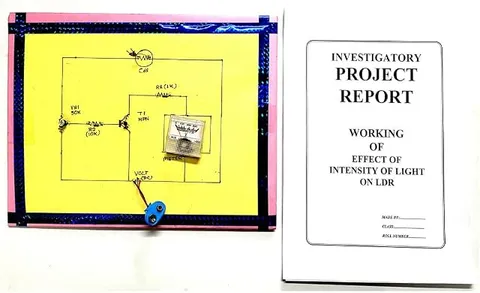
The sensing track of an LDR is a semiconductor, commonly cadmium sulphide. Kept in the dark, it has hardly any free charge carriers, and its resistance can reach around a megaohm. When light falls on it, photons give electrons enough energy to break free, the number of charge carriers rises and the resistance falls, to a few hundred ohms in bright light. This is called photoconductivity. In a circuit, the LDR is paired with a resistor in a voltage divider, whose output is Vout = Vin × R2 / (R1 + R2), with the output taken across R2. If R2 is the LDR, Vout rises as it gets darker, and once it crosses the switching level of a transistor the light turns on. For example, with Vin = 9 V and R1 = 10 kΩ, an LDR of 1 kΩ in light gives about 0.8 V, but 100 kΩ in the dark gives about 8.2 V.
Make it yourself
Make an LDR automatic candle with a comparator yourself
Build your own version from scratch, or use the steps to understand how the ready-made model is put together before you present it.
What you need 10
Step by step 8 steps
- Make the divider
The 10 kΩ resistor from the positive line to a junction, and the LDR from the junction to negative. The junction voltage rises as it gets darker.
Connect the junction to pin 3 of the LM358 (the non-inverting input), and connect the preset across the supply with its middle pin to pin 2 (the inverting input). Pin 8 goes to positive and pin 4 to negative.
Fit the 1 MΩ resistor from the output, pin 1, back to pin 3. This small positive feedback makes the candle snap on and off cleanly instead of flickering at dusk.
Connect pin 1 through the 4.7 kΩ resistor to the BC547's base, the emitter to negative, and each candle LED with its 330 Ω resistor between the positive line and the collector.
Switch on, cover the LDR and turn the preset until the LEDs just light; uncover it and they should go off.
Measure the LDR's resistance and the junction voltage in daylight, in room light and in darkness, and check the voltage against Vout = Vin × R2 / (R1 + R2), where R2 is the LDR.
- Find the switching points
Dim the light slowly by adding layers of tracing paper over the LDR, note the junction voltage at which the LEDs come on, then remove layers and note the slightly lower voltage at which they go off.
Fit the LEDs in the top of the candle tube under the tracing paper flame, and place the LDR low on the base facing outwards, away from the candle's own glow.
Read this first
Safety first
Go through these points before you build or switch anything on. Younger students should do this with an adult.
- Use the soldering iron only with an adult and rest it in its stand.
- Use LEDs only; never put a real flame near the cardboard candle.
- Keep the 330 Ω resistor with each LED and use only the 9 V battery.
- Fit the LM358 with its notch the right way; a reversed chip heats up quickly.
Troubleshooting
If something does not work
The usual problems with this model and how to fix them. Open a problem to see the fix.
The candle switches on and off rapidly at dusk
The LDR can see the candle's own light, or the hysteresis resistor is missing. Shield the LDR and point it away, and check the 1 MΩ resistor; a 470 kΩ resistor gives a wider gap between the on and off points.
The LEDs never light
The preset may be set too high, an LED may be reversed, or the transistor's legs may be mixed up. In darkness, pin 1 should read several volts; if it does, the fault is in the transistor or LEDs.
The LEDs stay on in daylight
The LDR and the 10 kΩ resistor may be swapped, which reverses the logic, or the preset is set too low. Check that the LDR goes from the junction to negative.
The LEDs flicker even in full darkness
That is the flicker chip inside each candle LED doing its job. For a steady night light, use ordinary LEDs instead.
Exhibition day
How to present it
A running order for the exhibition table or the practical, step by step.
Describe or measure the LDR's resistance in light and in darkness to show the change.
Write the voltage divider formula and work through one example on a chart.
Dim the room lights slowly and show the point at which the light switches on.
Compare an LDR with a photodiode and say why the LDR is cheaper but slower to respond.
Practice
Viva questions
Practice questions on this model, with short answers. Try each one aloud before you open the answer.
What is photoconductivity?
The increase in electrical conductivity of a material when light falls on it.
Which material is commonly used to make LDRs?
Cadmium sulphide (CdS).
Write the voltage divider formula.
Vout = Vin × R2 / (R1 + R2), where the output is taken across R2.
Does the resistance of an LDR increase or decrease in darkness?
It increases, because far fewer charge carriers are freed when no light falls on it.
Project file
Project file outline
The headings of the project file, in order. Give each heading its own section and write it in your own words.
Free ebook: Writing a Science Project FileContents
- Aim: to switch on an electronic candle automatically in the dark, using an LDR
- Introduction: photoconductivity and the LDR
- Theory: the voltage divider, Vout = Vin × R2 / (R1 + R2)
- The LM358 as a comparator, and why hysteresis stops flicker
- Circuit diagram and construction of the candle
- Observations: LDR resistance and divider voltage in different light
- Observations: the switch-on and switch-off voltages
- Applications: street lights, garden lamps and emergency lights
- Conclusion and bibliography
Buying checklist
Before you buy
What to check before you order the model, and what to do when it arrives.
1Before you order
- Check that the project suits your class, and whether your teacher wants a night light, a candle or both.
- Read the listing to see how it is powered and what kind of circuit it uses, so you explain the right one.
- Plan a cover such as a cup or box for the sensor, so you can show it switching in a bright hall.
- Keep the box for transport.
- Check the delivery date for your PIN code on the marketplace, and order well before the exhibition or practical.
2When it arrives
- Test it in a dark room as soon as it arrives, as exhibition halls are bright.
Next steps
Take it further
Ways to turn this model into a bigger investigation or a stronger exhibition entry.
Compare this comparator circuit with a single-transistor night lamp and describe how sharply each one switches.
Replace the 1 MΩ resistor with 470 kΩ and 2.2 MΩ and measure how the gap between the on and off points changes.
Use a phone light meter app to find the lux level at which the candle switches on, and plot LDR resistance against lux on a log scale.
Audience
Who it suits
Class 10 to 12 students preparing an investigatory project on semiconductors, sensors or voltage dividers.
- ClassClass 10 to 12
- SubjectPhysics
- TypeReady-made model
Free to read
Free ebooks for this topic
Free PDF ebooks from Gurukul Technicals Institute on the science, the making and the presenting of projects like this one.
- Free PDF ebook
Electricity and Magnetism Experiments
Hands-on experiments with cells, wires, bulbs and magnets
- Free PDF ebook
Physics Working Models Explained
Twenty classic models, how each works and how to make it
- Free PDF ebook
Investigatory Projects for Class 11 and 12
Topics, method and report structure for physics, chemistry and biology
- Free PDF ebook
Your Science Exhibition Guide
Choose a project, build it, present it and answer the judges with confidence