- Physics
- Ready-made model
- Class 1 to 9
Kutcha House and Pucca House Working Model and Project and Teaching Aid Educational Electronic Hobby Kit
Code B0DTYHWY4H
- Paid for and delivered by Amazon. The current price and the delivery date for your PIN code are shown there.
- Sold by Gurukul Technicals Institute, Delhi.
- Need a different topic, a custom version or a school order? Ask on WhatsApp.
In this project guide
Ready-made model
About this model
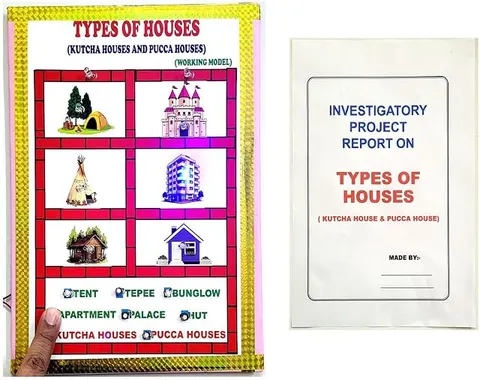
This model compares a kutcha house with a pucca house, helping young students understand the different kinds of homes people live in and the materials used to build them. It works both as an exhibition project and as a classroom teaching aid for lessons on shelter.
How it works
The science behind it
The idea the model demonstrates, in words you can use in your report and when you explain it.
A kutcha house is built with natural materials such as mud, bamboo, wood, straw and thatch. These are cheap and easy to find, and thick mud walls are poor conductors of heat, so they keep the inside cooler in summer and warmer in winter. But mud and thatch are damaged by heavy rain, floods and termites, so these houses need repair often. A pucca house uses bricks, cement, concrete, stone and steel. Concrete is very strong when pressed (in compression) but weak when stretched (in tension), so steel rods are placed inside it to make reinforced cement concrete (RCC), which can carry both kinds of force. Pucca houses last long and are safer in storms, but cost more to build. Sloping thatched roofs help rainwater run off quickly. Government schemes such as the Pradhan Mantri Awas Yojana help families replace kutcha houses with pucca ones.
Make it yourself
Make a kutcha house and pucca house model yourself
Build your own version from scratch, or use the steps to understand how the ready-made model is put together before you present it.
What you need 8
Step by step 8 steps
- Paint the two plots
Earthy brown ground for the village side and a paved path for the town side.
- Kutcha house
Build walls from small mud bricks, or press mud over a cardboard frame, leaving a door and a small window. Let it dry in the shade.
Make a sloping roof frame from sticks and cover it with dry grass or jute tied in small bundles, so rain runs off.
- Pucca house
Cut a door and windows in the box, glue on brick strips or draw brick lines, and paint part of it grey to show cement plaster.
Make a flat roof slab from card and leave one corner cut away to show toothpick 'steel rods' inside, explaining reinforced cement concrete.
Fit an LED inside each house with its resistor, and wire both to the battery through a switch hidden under the base so the houses light up.
Add people, trees and a water tank or well, and place label cards for each material.
Make a comparison chart beside the model: materials, cost, strength, comfort in heat and cold, and upkeep.
Read this first
Safety first
Go through these points before you build or switch anything on. Younger students should do this with an adult.
- Hot glue, cutters and cutting sticks need adult supervision.
- Wash your hands after working with mud or clay, and keep it away from the battery and wires.
- Dry grass catches fire easily, so light the houses only with LEDs; never use a candle or a bulb that gets hot.
- Use only the 9 V battery for the lights.
Troubleshooting
If something does not work
The usual problems with this model and how to fix them. Open a problem to see the fix.
The mud walls crack while drying
Mix a little more straw into the mud, make the walls thinner and dry them slowly in the shade. This is also why real mud walls are mixed with straw.
The thatch keeps falling off
Tie the grass into small bundles with thread, then glue the bundles in overlapping rows, starting from the bottom edge of the roof.
The lights do not come on
Check that each LED's long leg goes to positive through its resistor, and that no wire was pulled loose when the roof went on.
The model looks crowded
Leave space between the two houses and keep labels short, so visitors can compare them at a glance.
Exhibition day
How to present it
A running order for the exhibition table or the practical, step by step.
Place the two houses side by side and list the materials used in each on a small chart.
Explain one advantage and one disadvantage of each type of house.
Show why a sloping roof helps in rainy areas, using a drawing or a tilted sheet.
Ask the audience which type of house they would build in a flood-prone area, and why.
Practice
Viva questions
Practice questions on this model, with short answers. Try each one aloud before you open the answer.
What is a kutcha house made of?
It is made of natural materials such as mud, straw, bamboo, wood and thatch.
What is a pucca house made of?
It is made of strong materials such as bricks, cement, concrete, stone and steel.
Why do mud houses stay cool in summer?
Thick mud walls are poor conductors of heat, so they slow down the flow of heat from outside.
Why are steel rods put inside concrete?
Concrete is weak in tension, and steel rods make it strong against stretching and bending forces.
Project file
Project file outline
The headings of the project file, in order. Give each heading its own section and write it in your own words.
Free ebook: Writing a Science Project FileContents
- Aim: to compare a kutcha house and a pucca house and the materials used to build them
- Introduction: why every living being needs shelter
- Materials used in kutcha houses and their properties
- Materials used in pucca houses and their properties
- Reinforced cement concrete: why steel rods are placed inside concrete
- Comparison table: cost, strength, comfort, upkeep and safety in heavy rain
- How the two houses in the model were made
- Other kinds of houses in India, such as houseboats, stilt houses and tents
- Conclusion: which house suits which place, and why
Buying checklist
Before you buy
What to check before you order the model, and what to do when it arrives.
1Before you order
- Houses and shelter are taught in the primary and middle classes; check that the model matches your chapter.
- Read the listing to see whether the lights need batteries and whether they are included.
- Practise naming each material and saying why it is used.
- Keep the box, because thatch and small parts come off easily in a school bag.
- Check the delivery date for your PIN code on the marketplace, and order well before the exhibition or practical.
2When it arrives
- On arrival, check the thatch, walls and lights for transport damage, and fix small parts with glue.
Next steps
Take it further
Ways to turn this model into a bigger investigation or a stronger exhibition entry.
Test how quickly water soaks into a dried mud sample and a cement sample, and record the difference.
Put a thermometer inside a box with thick mud walls and another inside a thin cardboard box in the sun, and compare temperatures after an hour.
Add a third plot with an eco-friendly or earthquake-resistant house and explain its features.
Audience
Who it suits
Suits Class 3 to 6 EVS and social studies projects on houses and shelter, and works as a teaching aid in primary classes.
- ClassClass 1 to 9
- SubjectPhysics
- TypeReady-made model
Free to read
Free ebooks for this topic
Free PDF ebooks from Gurukul Technicals Institute on the science, the making and the presenting of projects like this one.
- Free PDF ebook
Physics Working Models Explained
Twenty classic models, how each works and how to make it
- Free PDF ebook
Your Science Exhibition Guide
Choose a project, build it, present it and answer the judges with confidence
- Free PDF ebook
Writing a Science Project File
How to write the report, from the cover page to the bibliography
- Free PDF ebook
Viva Questions for Science Projects
How to answer examiner questions, with sample questions for popular projects