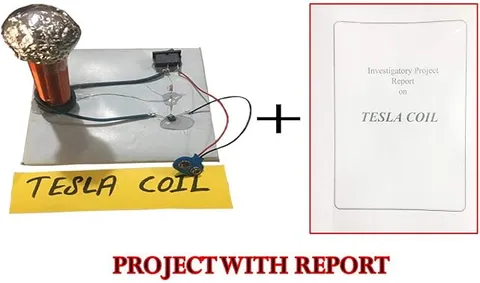
Handmade Tesla Coil Educational Circuit Board
Code B07H5PPBVN
- Paid for and delivered by Amazon. The current price and the delivery date for your PIN code are shown there.
- Sold by Gurukul Technicals Institute, Delhi.
- Need a different topic, a custom version or a school order? Ask on WhatsApp.
In this project guide
Physics
About this model
A handmade educational Tesla coil circuit board that builds up a strong, high-frequency electric field around its coil. It is a striking way to demonstrate resonance, transformers and wireless energy transfer, and small Tesla coils are often shown lighting a fluorescent tube held near them with no wires attached.
How it works
The science behind it
The idea the model demonstrates, in words you can use in your report and when you explain it.
A Tesla coil is an air-core transformer that uses resonance to produce a very high voltage at high frequency. The primary coil has only a few turns of thick wire, while the secondary has hundreds of turns of thin wire. In small educational versions, a transistor circuit drives the primary with a rapidly changing current. By mutual induction, this changing current induces a voltage in the secondary, and for an ideal transformer Vs/Vp = Ns/Np, so many more turns give a much higher voltage. The secondary coil and its own capacitance form a resonant circuit with natural frequency f = 1/(2π√(LC)); driven at this frequency, the voltage builds up far beyond the simple turns ratio. The strong, rapidly changing electric field near the top can make the gas inside a fluorescent tube glow without any wires. Wireless phone chargers also pass energy between two coils, though at a much lower voltage.
Make it yourself
Make a mini Tesla coil yourself
Build your own version from scratch, or use the steps to understand how the ready-made model is put together before you present it.
What you need 10
Step by step 9 steps
Tape the start of the thin wire near the bottom of the pipe and wind close, neat turns with no gaps or overlaps until about 2 cm from the top. Hold the end with tape and coat the winding with varnish or wrap it with tape.
Scrape the enamel off both ends of the secondary wire.
Fix the coil upright on the base. Connect the bottom end of the secondary to the transistor's base, and leave the top end standing up as a short free wire.
Wind two or three loose turns of the thick wire round the bottom of the secondary as the primary. Connect one end to battery positive through the push button and the other end to the transistor's collector.
Connect the 22 kΩ resistor from battery positive (after the push button) to the base, and the transistor's emitter to battery negative.
Connect the protective LED or diode between base and emitter facing backwards: its banded or short-leg end to the base, its other end to the emitter. Fix the transistor on its heat sink.
Press the button for a few seconds and hold the fluorescent tube near the top of the coil, without touching it. It should glow.
If nothing happens, swap the two ends of the primary coil and try again.
Never hold the button down for more than about 20 to 30 seconds at a time; let the transistor cool between demonstrations.
Read this first
Safety first
Go through these points before you build or switch anything on. Younger students should do this with an adult.
- Do not touch the top of the coil while it is running: even a battery-powered coil makes a high-frequency high voltage there that can sting or cause a small burn.
- Power it only from a battery of up to 12 V, never from the mains or a home-made mains supply.
- Keep phones and laptops away, keep the coil well away from anyone with a pacemaker or other medical implant, and keep paper and other things that could catch fire away from any sparks.
- The transistor and its heat sink get hot, so run the coil only in short bursts.
- Handle the fluorescent tube carefully; if one breaks, let an adult clear it up, as the tube contains a small amount of mercury.
Troubleshooting
If something does not work
The usual problems with this model and how to fix them. Open a problem to see the fix.
Nothing happens and the transistor stays cool
The circuit is not oscillating. Swap the two primary wires, check that the enamel is scraped off the secondary's ends, and check the coil for a broken wire.
The transistor gets hot within seconds but the tube does not light
The primary is connected the wrong way or the protective LED or diode is reversed. Release the button, swap the primary wires, and check the LED's direction.
The tube glows only when it touches the top wire
The field is weak. Use a fresh battery or the 12 V pack, and check that the secondary has several hundred neat turns.
The protective LED glows while the coil runs
That is normal in this circuit and shows that it is oscillating.
Exhibition day
How to present it
A running order for the exhibition table or the practical, step by step.
Keep a safe distance, do not touch the top of the coil while it runs, and keep phones and other electronics away.
Bring a fluorescent tube or CFL near the coil to show it glowing without wires, and explain why.
Explain the turns ratio of the primary and secondary with a simple transformer diagram.
Switch it off between demonstrations, because the driver circuit can heat up in continuous use.
Practice
Viva questions
Practice questions on this model, with short answers. Try each one aloud before you open the answer.
What is a Tesla coil?
It is a resonant air-core transformer that produces a very high voltage at high frequency.
Why does a fluorescent tube glow near a Tesla coil without wires?
The strong high-frequency electric field around the coil excites the gas inside the tube, which then gives out light.
On what principle does a Tesla coil transfer energy from primary to secondary?
Mutual induction, in which a changing current in one coil induces an EMF in a nearby coil.
What is the resonant frequency of an LC circuit?
It is f = 1/(2π√(LC)), the frequency at which the circuit naturally oscillates.
Project file
Project file outline
The headings of the project file, in order. Give each heading its own section and write it in your own words.
Free ebook: Writing a Science Project FileContents
- Aim: to build a mini Tesla coil and show wireless transfer of energy by lighting a fluorescent tube
- Introduction: Nikola Tesla and the resonant transformer he invented in 1891
- Mutual induction and the turns ratio, Vs/Vp = Ns/Np
- Resonance in the secondary coil: f = 1/(2π√(LC))
- The single-transistor oscillator circuit
- Construction: winding the primary and secondary coils
- Observations: how far from the coil the tube lights, with a 9 V and a 12 V supply
- Safety precautions, and related technology such as wireless charging pads and induction heating
- Conclusion and bibliography
Buying checklist
Before you buy
What to check before you order the model.
1Check these first
- Check that your school allows a Tesla coil at the exhibition, because it makes a strong high-frequency field; tell your teacher in advance.
- Read the listing to see what battery the model needs and whether a tube or bulb for the demonstration is mentioned.
- Test it in short bursts a few days before the exhibition, and keep a spare battery.
- Pack the coil and any fluorescent tube carefully, and keep the box for transport.
- Check the delivery date for your PIN code on the marketplace, and order well before the exhibition or practical.
- Practise explaining it. Judges ask what the model shows and why; knowing the science matters as much as the model. The viva questions above are a good place to start.
Next steps
Take it further
Ways to turn this model into a bigger investigation or a stronger exhibition entry.
Measure the greatest distance at which the tube glows for different supply voltages or numbers of turns, and plot the results.
Show that the tube glows brighter at the end nearer the coil, and explain it using the strength of the electric field.
Estimate the secondary's resonant frequency from its inductance and capacitance, and with your teacher's help check it on an oscilloscope in the school laboratory.
Audience
Who it suits
Suits Class 11 and 12 physics exhibitions on electromagnetic induction and alternating current, with a teacher present.
- SubjectPhysics
Free to read
Free ebooks for this topic
Free PDF ebooks from Gurukul Technicals Institute on the science, the making and the presenting of projects like this one.
- Free PDF ebook
Electricity and Magnetism Experiments
Hands-on experiments with cells, wires, bulbs and magnets
- Free PDF ebook
Physics Working Models Explained
Twenty classic models, how each works and how to make it
- Free PDF ebook
Your Science Exhibition Guide
Choose a project, build it, present it and answer the judges with confidence
- Free PDF ebook
Writing a Science Project File
How to write the report, from the cover page to the bibliography