- Physics
- Ready-made model
- Class 10 to 12
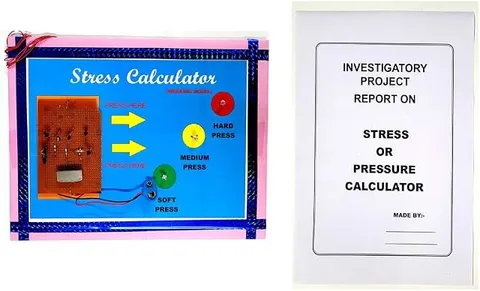
Stress Pressure Calculator Physics Educational Investigatory Project for School & Colleges
Code B0DK22BDXX
- Paid for and delivered by Amazon. The current price and the delivery date for your PIN code are shown there.
- Sold by Gurukul Technicals Institute, Delhi.
- Need a different topic, a custom version or a school order? Ask on WhatsApp.
In this project guide
Ready-made model
About this model
This investigatory project is about stress and pressure, two quantities that both measure force spread over an area. The title does not say how the model takes its readings, so check the listing for how it works; the physics behind it is explained below. It is a useful project for students who want to connect formulas with real objects such as knives, nails and building materials.
How it works
The science behind it
The idea the model demonstrates, in words you can use in your report and when you explain it.
Pressure is the force acting perpendicular to a surface divided by the area: p = F/A, measured in pascal (Pa), where 1 Pa = 1 N/m². The same force gives more pressure on a smaller area; a 500 N push spread over 0.05 m² gives 10,000 Pa, but over 0.0005 m² it gives 1,000,000 Pa. Stress looks similar, stress = F/A, and has the same unit, but it describes the internal restoring force per unit area that develops inside a solid when it is deformed. Stress can be tensile (pulling), compressive (squeezing) or shearing (sliding). The fractional change in size or shape is called strain, which has no unit. Within the elastic limit, stress is proportional to strain (Hooke's law), and Young's modulus, Y = longitudinal stress/longitudinal strain, tells how stiff a material is. A sharp knife cuts vegetables easily because its thin edge concentrates force on a tiny area.
Make it yourself
Make a pressure and stress demonstration model yourself
Build your own version from scratch, or use the steps to understand how the ready-made model is put together before you present it.
What you need 8
Step by step 8 steps
Weigh the platform with its legs, measure the area of one leg end and multiply by four for the total contact area, then convert cm² to m² by dividing by 10,000.
Smooth the sand flat with a ruler, stand the platform on it on its pencil legs, add a known mass and measure how deep the legs sink.
Repeat with the same mass on the bottle-cap legs and then on the block legs, smoothing the sand before each trial.
For each trial work out the force F = m × g, where m is the added mass plus the platform's own mass in kg and g = 9.8 m/s², and the pressure p = F/A, and write them in a table beside the depth.
Hang a rubber band from the hook with the pan below it, note its length, and measure its width and thickness to find its cross-sectional area.
Wearing goggles, add masses one at a time and record the stretched length each time; then remove them and check whether the band returns to its starting length.
Work out stress = F/A and strain = change in length ÷ original length for each load, and plot stress against strain.
- Make a calculator card
A ready table of pressure for common masses and contact areas, so visitors can pick a mass and an area and read off the pressure.
Read this first
Safety first
Go through these points before you build or switch anything on. Younger students should do this with an adult.
- Keep feet and fingers clear of the hanging weights, and add them gently.
- Wear goggles and keep your face away while stretching the rubber band, because it can snap and fly back.
- Keep sand and flour away from your eyes, and sweep up spills so nobody slips.
- Use flat-ended legs only; do not use sharpened pencils or nails, which can prick fingers.
Troubleshooting
If something does not work
The usual problems with this model and how to fix them. Open a problem to see the fix.
The legs make dents too small to measure
The sand is packed too firmly or the mass is too small. Loosen the sand, use flour or a thick sponge, or add more mass.
Readings change every time I repeat a trial
The surface is not the same each time. Smooth it with a ruler before every trial, lower the platform gently, and take the average of three readings.
The rubber band does not go back to its starting length
It has gone past its elastic limit. Use a new band with smaller loads, and note the load at which it stopped returning.
My pressure values look far too small
Check the units: area must be in m² and mass in kg. Using the area in cm² as if it were m² makes the answer 10,000 times too small.
Exhibition day
How to present it
A running order for the exhibition table or the practical, step by step.
Work out one pressure example live on a chart, changing only the area to show its effect.
Explain the difference between pressure (external) and stress (internal) before the judges ask.
Bring everyday objects, such as a nail, a drawing pin and a broad-strap bag, to illustrate high and low pressure.
State all units carefully: pascal for pressure and stress, and no unit for strain.
Practice
Viva questions
Practice questions on this model, with short answers. Try each one aloud before you open the answer.
What is the SI unit of pressure and stress?
The pascal (Pa), which equals one newton per square metre.
How is stress different from pressure?
Pressure is the external force per unit area acting normally on a surface, while stress is the internal restoring force per unit area that develops in a deformed body.
State Hooke's law.
Within the elastic limit, stress is directly proportional to strain.
Why does a sharp knife cut better than a blunt one?
Its edge has a much smaller area, so the same force produces a much greater pressure.
Project file
Project file outline
The headings of the project file, in order. Give each heading its own section and write it in your own words.
Free ebook: Writing a Science Project FileContents
- Aim: to study pressure and stress as force per unit area
- Definitions of force, thrust, pressure, stress and strain, with their units
- Types of stress: tensile, compressive and shearing
- Hooke's law and the elastic limit
- Experiment 1: depth of the dent for the same force on different areas
- Experiment 2: stretching a rubber band, with a stress-strain graph
- Calculations, and how the calculator card was made
- Everyday applications: sharp knives, nails, wide tyres and building foundations
- Conclusion and sources of error
Buying checklist
Before you buy
What to check before you order the model, and what to do when it arrives.
1Before you order
- The title does not say how this model takes its readings, so read the listing carefully, or ask the seller, before buying.
- Check with your teacher whether your project should show pressure, stress or both, at your class level.
- Do not assume weights, batteries or a report are included unless the listing says so.
- Keep the box for transport and pack any loose parts separately.
- Check the delivery date for your PIN code on the marketplace, and order well before the exhibition or practical.
- Practise explaining it. Judges ask what the model shows and why; knowing the science matters as much as the model. The viva questions above are a good place to start.
2When it arrives
- When it arrives, try a few calculations with it and check the answers by hand using p = F/A.
Next steps
Take it further
Ways to turn this model into a bigger investigation or a stronger exhibition entry.
Repeat the stretching test with a thin copper wire and compare how stiff it is with the rubber band.
Work out the pressure under your own feet when standing on two feet, on one foot and on tiptoe, using your weight and traced foot areas.
Make a panel explaining with p = F/A why a bed of many nails spreads the force; do not try it with real nails.
Audience
Who it suits
Class 8 projects on force and pressure, and Class 11 physics projects on the mechanical properties of solids.
- ClassClass 10 to 12
- SubjectPhysics
- TypeReady-made model
Free to read
Free ebooks for this topic
Free PDF ebooks from Gurukul Technicals Institute on the science, the making and the presenting of projects like this one.
- Free PDF ebook
Physics Working Models Explained
Twenty classic models, how each works and how to make it
- Free PDF ebook
Investigatory Projects for Class 11 and 12
Topics, method and report structure for physics, chemistry and biology
- Free PDF ebook
Your Science Exhibition Guide
Choose a project, build it, present it and answer the judges with confidence
- Free PDF ebook
Writing a Science Project File
How to write the report, from the cover page to the bibliography