61% off
- Biology
- Ready-made model
- Printed report included
Human Circulatory System with LED Light Science Biology Working Project Model
Code B0HLY46D2R
- Paid for and delivered by Amazon. The current price and the delivery date for your PIN code are shown there.
- Sold by Gurukul Technicals Institute, Delhi.
- Need a different topic, a custom version or a school order? Ask on WhatsApp.
In this project guide
Ready-made model
About this model
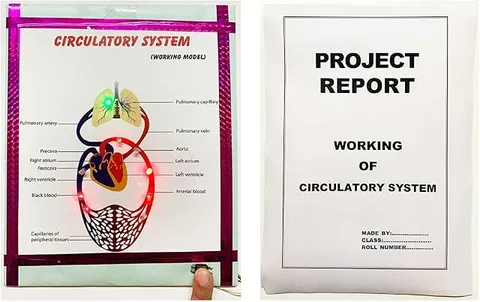
This biology working model is a labelled chart of the human circulatory system, showing the heart, the lungs and the blood vessels in red and blue on a black background. In the photo, most labels, from the right atrium and aorta to the pulmonary capillaries, have a metal terminal beside them, and touching a terminal with the probe on the purple wire lights a small LED at that part. A switch sits at the bottom left, and a printed report cover is shown beside it.
How it works
The science behind it
The idea the model demonstrates, in words you can use in your report and when you explain it.
The human circulatory system is made of the heart, the blood vessels and the blood. The heart has four chambers: two upper atria that receive blood and two lower ventricles that pump it out. Humans have double circulation, so blood passes through the heart twice in each complete round. Deoxygenated blood from the body enters the right atrium through the venae cavae; the precava, or superior vena cava, brings it from the head and arms. The right ventricle pumps it through the pulmonary artery to the lungs, where the pulmonary capillaries take in oxygen and give out carbon dioxide. Oxygenated blood returns through the pulmonary veins to the left atrium, and the left ventricle, which has the thickest wall, pumps it through the aorta to the whole body. In the capillaries of the body tissues, oxygen and food pass into the cells and wastes pass into the blood. Valves stop blood flowing backwards, and their closing makes the lub-dub sound of a heartbeat.
Make it yourself
Make a light-up circulatory system quiz board yourself
Build your own version from scratch, or use the steps to understand how the ready-made model is put together before you present it.
What you need 9
Step by step 8 steps
Paste the diagram on the board, colouring vessels with oxygenated blood red and those with deoxygenated blood blue, and add a small colour key.
Fix a label beside each part you want to quiz on: the four chambers, the venae cavae, the pulmonary artery and vein, the aorta, and the capillaries of the lungs and the body tissues.
Push an LED through the board at each part so it shines from the front, and fix a washer terminal with a bolt beside each matching label.
At the back, join each LED's long leg to the bolt of its own washer with a short wire.
Join all the LEDs' short legs together with one common wire and connect it to the battery's negative terminal.
Connect the battery's positive terminal through the switch and the 1 kΩ resistor to the probe wire, and bring the probe out to the front.
Switch on and touch each washer with the probe; only the LED at that part should light. Fix any that do not before closing the back.
Tape all the wiring flat at the back, fix the battery firmly and add a small hook to hang the probe on.
Read this first
Safety first
Go through these points before you build or switch anything on. Younger students should do this with an adult.
- Never join the two battery terminals directly with a wire, and unclip the battery when the board is not on show.
- Keep the resistor in the probe line; without it, the first LED you touch will burn out.
- Make the holes for the bolts with a bradawl or hand drill only with an adult.
- Keep small washers, nuts and bolts away from young children.
Troubleshooting
If something does not work
The usual problems with this model and how to fix them. Open a problem to see the fix.
One LED never lights
It may be the wrong way round, or its wire to the washer may be loose. Turn the LED so its long leg goes to the washer, and check the joint.
Two LEDs light together
Two washer wires are touching at the back, or the probe is touching two washers. Separate the wires and tape every joint.
No LED lights anywhere
Check the battery, the switch, the resistor in the probe line and the common wire from the short legs to the battery negative.
An LED flickers when touched
The washer is dirty or loose. Tighten its nut and rub the washer with fine sandpaper so the probe makes good contact.
Exhibition day
How to present it
A running order for the exhibition table or the practical, step by step.
Ask the examiner to name a part, then touch its terminal with the probe so the LED at that part lights while you explain its job.
Trace one complete round of blood with your finger, starting at the right atrium and naming each chamber and vessel in order.
Explain the red and blue colour code, and point out that the pulmonary artery carries deoxygenated blood while the pulmonary vein carries oxygenated blood.
Let a visitor feel their pulse at the wrist and explain that each beat comes from the left ventricle pumping blood into the arteries.
Practice
Viva questions
Practice questions on this model, with short answers. Try each one aloud before you open the answer.
Why is the wall of the left ventricle thicker than that of the right ventricle?
The left ventricle pumps blood to the whole body, which needs much more force than sending blood only to the lungs.
What is the precava?
The precava, or superior vena cava, is the large vein that brings deoxygenated blood from the head, neck and arms into the right atrium.
Which vein carries oxygenated blood?
The pulmonary vein, which brings oxygenated blood from the lungs to the left atrium.
Why is human circulation called double circulation?
Because blood passes through the heart twice in one complete round, once on its way through the lungs and once on its way through the rest of the body.
Project file
Project file outline
The headings of the project file, in order. Give each heading its own section and write it in your own words.
The listing includes a printed project report: use this outline to check that your own file covers every part.
Free ebook: Writing a Science Project FileContents
- Aim: to identify the parts of the human circulatory system with a light-up quiz board
- Introduction: the heart, the blood vessels and the blood
- Structure of the heart: four chambers and valves
- Double circulation: pulmonary and systemic circulation
- Arteries, veins and capillaries
- Circuit diagram of the quiz board and how the probe completes the circuit
- Observations: how many parts visitors identified correctly
- Keeping the heart healthy: exercise, a balanced diet and avoiding smoking
- Conclusion and bibliography
Buying checklist
Before you buy
What to check before you order the model, and what to do when it arrives.
1Before you order
- Check that transportation in human beings is in your syllabus and whether your teacher wants a working model.
- Find out how the lights are powered and keep a fresh battery of that type for the exhibition day.
- Keep the box and carry the board flat so the LEDs and wires on the back are not bent.
- Check the delivery date for your PIN code on the marketplace, and order well before the exhibition or practical.
- The project report is a learning aid. Read it, understand how the model works, and write your own observations; schools expect your own work.
- Practise explaining it. Judges ask what the model shows and why; knowing the science matters as much as the model. The viva questions above are a good place to start.
2When it arrives
- The listing says a printed report is included; check what arrives against the photo: the chart, the probe, the switch and the report.
- Touch every terminal with the probe soon after it arrives and note any part whose LED does not light.
Next steps
Take it further
Ways to turn this model into a bigger investigation or a stronger exhibition entry.
Measure classmates' pulse rates at rest and after a minute of skipping, and plot the results as a bar chart.
Add a small side diagram comparing the double circulation of humans with the single circulation of a fish.
Make question cards, such as which chamber pumps blood to the whole body, and let visitors answer by touching the right terminal.
Audience
Who it suits
Suits Class 7 to 10 biology exhibitions and lessons on transportation in human beings, and quick revision of the parts of the heart before a viva.
- SubjectBiology
- TypeReady-made model
- Project reportPrinted report included
Free to read
Free ebooks for this topic
Free PDF ebooks from Gurukul Technicals Institute on the science, the making and the presenting of projects like this one.
- Free PDF ebook
Biology Models Guide
Make the heart, lungs, kidney, eye, cell and more, and explain them well
- Free PDF ebook
Electricity and Magnetism Experiments
Hands-on experiments with cells, wires, bulbs and magnets
- Free PDF ebook
Your Science Exhibition Guide
Choose a project, build it, present it and answer the judges with confidence
- Free PDF ebook
Writing a Science Project File
How to write the report, from the cover page to the bibliography